
Financial planning and analysis for good decision making.
Chile-based environmental advocacy charity FIMA has a strong record of managing its funder grants, keeping diligently within spend requirements, and being cautious with its unrestricted monies.
It was time to evolve and also 'step back' to view the overall FIMA Finances at organization-level:
The bank balance was healthy, but how much was grants part way through maturity, and how much ‘real’ reserve funds?;
To what extent were committed costs over the near future covered by secured/planned income?
How would finances would look over the next 1-2 years in various (income and spend) scenarios ?
Not only were answers needed now – particularly for some logjammed decisions around, eg, whether desired pay-rises could be afforded – but processes and tools to make similar analysis going forward would also be valuable for the Finance team – who could then more constructively advise in leadership decisions on planning on fundraising and spending.
The Work
The project team was FIMA’s Finance team (Maca and Cata) and Steve Sweet, a qualified accountant based in the UK with experience in charity financial planning. Carried out over several weeks in summer 2024, regular 1.5 to 2 online coaching/ working sessions connected London and Santiago.
First, an exercise was needed to see what was the 'true’ baseline of Free Reserves, stripping out the timing differences of some 20+ live grants – some of which paying in advance, others in arrears - and all in various stages of spend progress. The work produced a clearer organization-wide financial picture for FIMA, using accrual-based analysis to illuminate what baseline unrestricted funds were truly at its disposal. This became a vital starting point for financial planning. A simplified version of the Balance Sheet is shown!
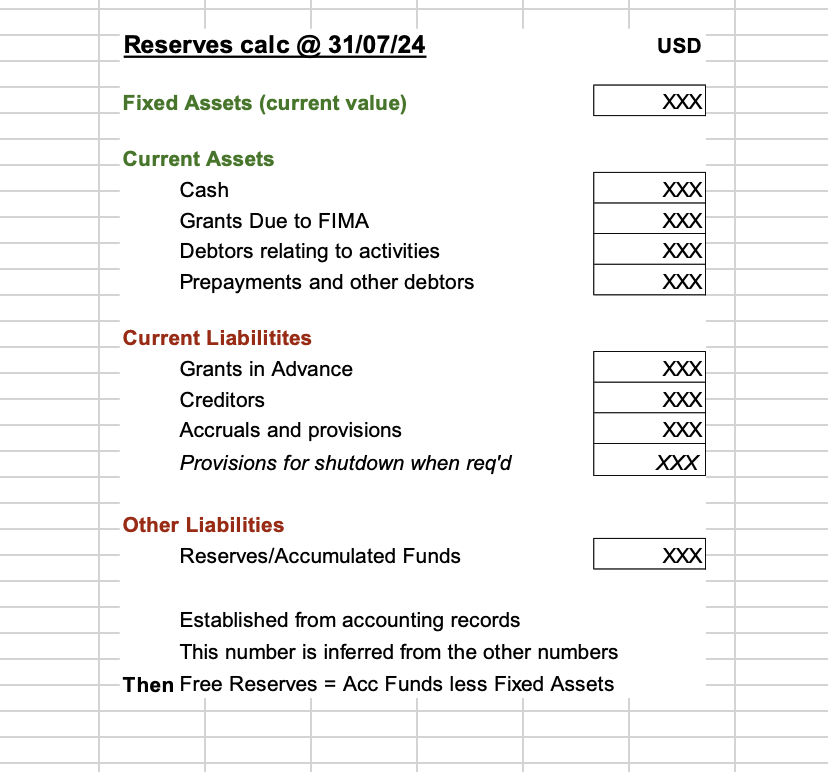
Next, a view on what a sensible level of reserves might be for FIMA going forward was needed. Too little could risk short-term income or cash shortages, if unexpected income or costs shocks arose, but too much risked missing chances to further mission or raise further funds. With the critical guidance and framework for Steve, and discussion, a new balanced distribution was reached, and we could compare that to the current situation (finding opportunities for optimization)
To look at how the future could play out, a bespoke Income and Expenditure Excel model was built and co-populated (see graphic). A ‘window’ of 17 months, broken into c. 6 month planning increments, was used to balance planning with uncertainty. Pragmatic management accounting training was passed on, with concepts such as matching incomes and expenses to time periods to iron out tricky timing illusions produced by cashflow-only accounting. Incomes and expected costs for both a Base-Case and Best Case-scenario were apportioned to the periods, illuminating the extent to which current revenue plans covered costs overall.
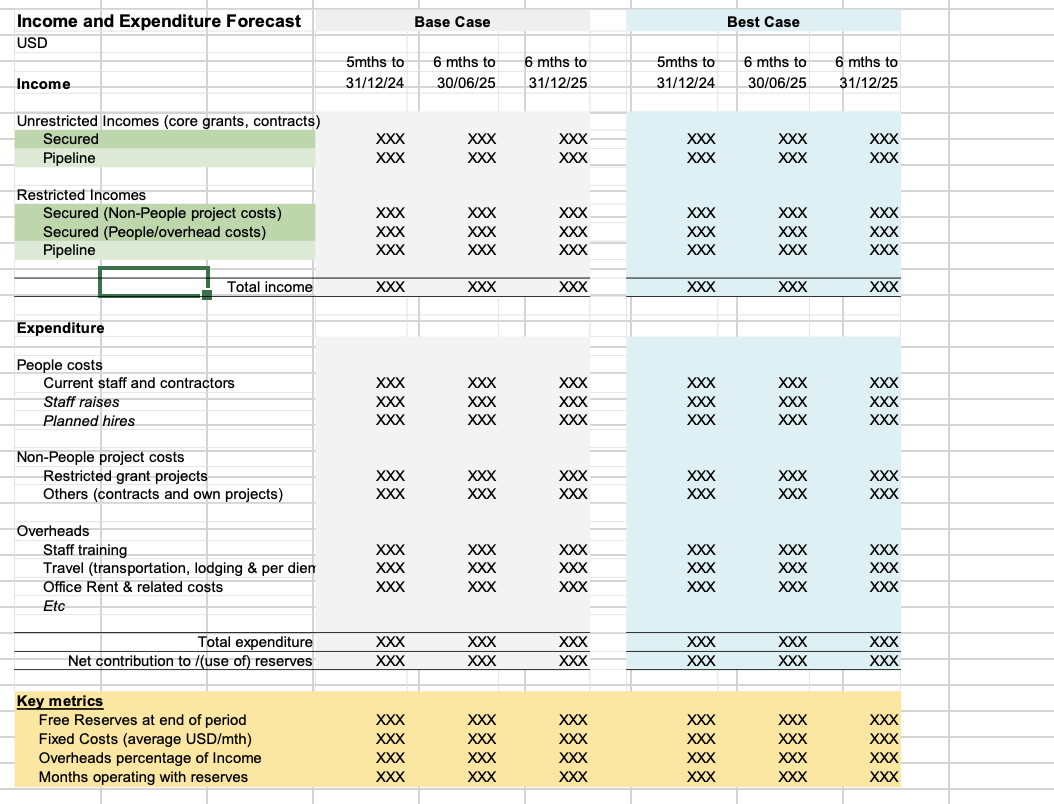
Gradually, as we populated the templates together, more clarity emerged on whether the business model was on track; where cost trade-offs might be needed in the future; and the extent to which new fundraising plans covered staff retaining and overall growth.
How did it go, 18 months on…
Maca from FIMA comments: “We now have a clearer picture of our financial situation, which allows us to make future decisions with greater confidence. Without this certainty, we had to operate with extreme caution, which meant we couldn’t, for example, determine whether we could afford to give our staff a pay raise.
“Definitely the biggest change for us was gaining confidence that what we're doing is right for the safe administration of our funds. Now we have an improved and validated decision-making tool, tailored for our non-profit model of administration. This allows us to see the bigger picture, adapt our decisions to the current scenarios and adapt if necessary.”
The work has also informed a follow-on project, also through Non-Profit Builder, to develop a formalized fundraising strategy in line with a broader charitable strategy. Finance have felt more confident in integrating into this fundraising strategy work, and the strategy is linking with financial sustainability needs.
On what Maca would say to another organization considering a similar engagement: “I would tell them to seize the opportunity without hesitation. I would also tell them that it may require a lot of hard work and dedication, but the results are worth it”.
From Steve’s point of view: “it was very gratifying to know the work helped free FIMA up to continue its important mission, with new confidence and insight. It was vital that FIMA were willing to ask the ‘why’ questions, and being sure they understood, during the process; this helped them build capacity and confidence to operate going forward”.