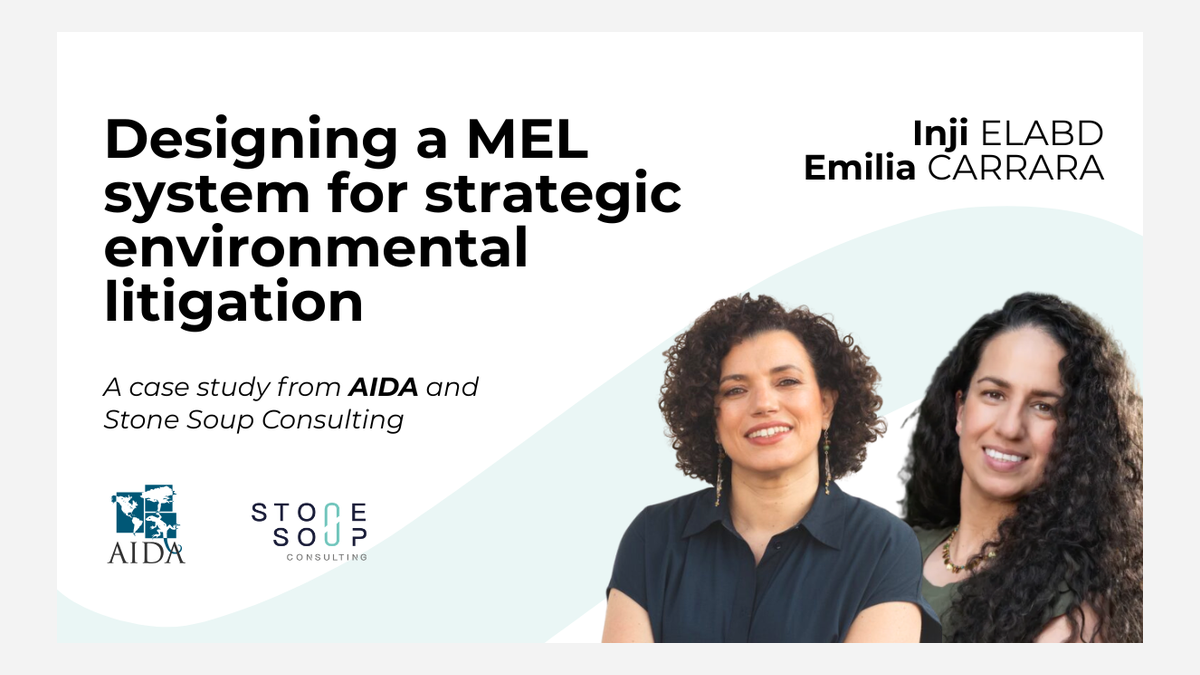
Monitoring, Evaluation and Learning practitioners working with litigation and advocacy organisations have long wrestled with a structural mismatch: the frameworks commonly used were built for a different kind of work.
Logframes assume countable outputs and plausible attribution. Results matrices assume that change happens within project cycles. Neither assumption holds in strategic litigation, where a brief filed today may reshape environmental jurisprudence five years from now, through mechanisms that run simultaneously through courts, regulatory bodies, scientific institutions, and public opinion.
AIDA, the Interamerican Association for Environmental Defense, approached Stone Soup Consulting to design its MEL system for the 2024–2027 Strategic Plan, this mismatch was the starting point. What followed was an eight-month process of diagnosis, co-design, and methodology transfer that produced Legal Outcome Mapping (LOM): a framework built specifically for complex, multi-actor legal strategies.
What the diagnosis revealed
Before designing a MEL system, our team spent several months learning how AIDA actually worked. We reviewed strategic documents, conducted leadership interviews, facilitated workshops, and ran a survey. The picture that emerged was one of a learning organisation. AIDA's teams generated significant information, tracking cases, documenting interactions with stakeholders, and registering outcomes. The challenge remained to find a common system that works across strategies and program areas and that is also easy to maintain.
At the same time, the team felt a genuine desire to develop a more rigorous monitoring, evaluation and learning system, alongside a real concern that more structure would mean more administrative burden. It was evident that AIDA had a wealth of knowledge, and that it was time to connect, organise, and strengthen capacities that already existed; not to install a system from the outside.
The methodological challenge
AIDA's mission is to strengthen people’s ability to defend their right to a healthy environment by using the law, science, and communications to protect ecosystems and communities across Latin America.
To achieve this, their work expands over four main program areas: climate, ocean, human rights, and territories. Six main strategies make all this work happen, including legal cases, scientific evidence, community-based work, communications, policy advocacy, and protection.

AIDA’s programmatic areas share an organisational home but operate through fundamentally different -and complex- theories of change and with multidisciplinary teams, including lawyers, economists, scientists, and communicators. Moreover, AIDA's teams operate in a fast-moving sector requiring attentiveness and timely interventions.
The diversity was too great. The breakthrough came from a different question:
What do all of AIDA's strategies share? What is the common denominator across themes, strategies, and geographies? How can we build a solid system that does not burden busy teams?
The answer was stakeholder change. Whether AIDA files a legal brief, publishes a scientific report, or accompanies an Indigenous community through a regulatory proceeding, the operative mechanism is always the same: a specific actor, such as a judge, a regulator, a legislator, a development bank, changes their position, behaviour, relationship, or capacity in ways that advance the protection of the human right to a healthy environment. This is how AIDA produces change, across every programme, every geography, every strategy.
This insight, drawn from Outcome Mapping's contribution-over-attribution logic and Outcome Harvesting's actor-centred approach to complex systems change, unlocked a common unit of analysis. The same core questions applied everywhere: who changed, what changed, and how did AIDA contribute to that shift?
The Legal Outcome Mapping framework
Over eight months, AIDA and Stone Soup worked together closely, through knowledge transfer sessions, co-creation sessions, and asynchronous validation exercises. Together we designed Legal Outcome Mapping (LOM) — a framework that integrates Outcome Mapping, Outcome Harvesting, and complex multi-actor advocacy evaluation practice into a system grounded in the logic of legal strategy. At its core is Case Theory: a practice already familiar to their legal teams, repurposed as the unit from which all monitoring flows. From there, the system tracks how actors change across the case ecosystem, consolidates that information at the programme level, and transforms it into institutional evidence for leadership, fundraising, and communications.
Governance was co-designed with the same logic: clear roles at each level, from the case manager who registers changes as they occur, to the programme focal point who consolidates them in an accessible format, to the MEL lead who produces evidence, so that accountability is distributed without creating new layers of management. The system also creates an explicit link between day-to-day case operation and the strategic plan, allowing the organisation to read how individual cases connect to institutional objectives, and where gaps exist between strategy and practice.
The framework was validated by applying it to a successful litigation case study, and tools were adjusted to reflect the available information and the capacity to collect information within the cases.
Six design principles
The framework was built around six principles, defined with AIDA's team:
Structure without bureaucracy. Operational clarity over rigid formalisation.
Fixed outcomes, negotiable tools. A common indicator floor that enables institutional comparison, combined with real flexibility at the programme level. This resolves the apparent contradiction between comparability and adaptation.
Built from the inside. The Design and Implementation Committee and the Steering Committee co-designed the system. They did not receive it.
Lightness as a condition of survival. If the system does not fit into real workflow, it will not survive
Learning, not just reporting. The complete cycle is registration, analysis, decision, and learning.
Minimal administrative burden for operational teams.
What this suggests for complex systems MEL
The unit of analysis is the key design decision. In complex advocacy, what you choose to measure determines what you can see. Stakeholder change is more honest and more tractable than outputs or activities for organisations working through indirect mechanisms over long time horizons.
Diagnosis before design. AIDA had already generated substantial information. Building on existing practices rather than overlaying a new system was both more efficient and more likely to survive.
Appropriation requires genuine agency. The distinction between consultation and co-creation is not rhetorical. It is the difference between a system that lasts and one that doesn't.
Flexibility and rigour are not in tension. The fixed-outcome / flexible-tool architecture is the practical resolution. Standardise what needs to be compared; adapt everything else.
About AIDA:
AIDA - Interamerican Association for Environmental Defense is a pioneer regional organisation of environmental legal experts from and based in Latin America working for environmental protection and climate justice. For over 28 years, AIDA has used the law and science to protect some of the world’s most vulnerable and endangered habitats and communities in the region suffering from environmental harm. With Justice, Governance, and Partnership as its pillars, AIDA prioritizes high-need, high-impact cases that can set replicable precedents, therefore fundamentally changing laws to fortify environmental protection and address the climate crisis.
About the authors:
Emilia Carrara, AIDA’s Director of Strategy
With a background in environmental science, Emilia has worked with AIDA for over nine years, supporting the strengthening of institutional strategy, development processes, and internal capacity-building.
Inji ElAbd, Principal Consultant at Stone Soup and Project Coordinator
With a background in economics, international cooperation and art therapy, Inji is an evaluator specializing in complex portfolios, intersectional evaluation and participatory and arts-based methods.
The Project team at Stone Soup included Andrés Trujillo Lentini , Federico Diaz Sahr, Samantha Colli with Claudia Pedra, Stone Soup Managing Partner, as Project Supervisor.
Stone Soup Consulting · stone-soup.net · stone-soup@stone-soup.net