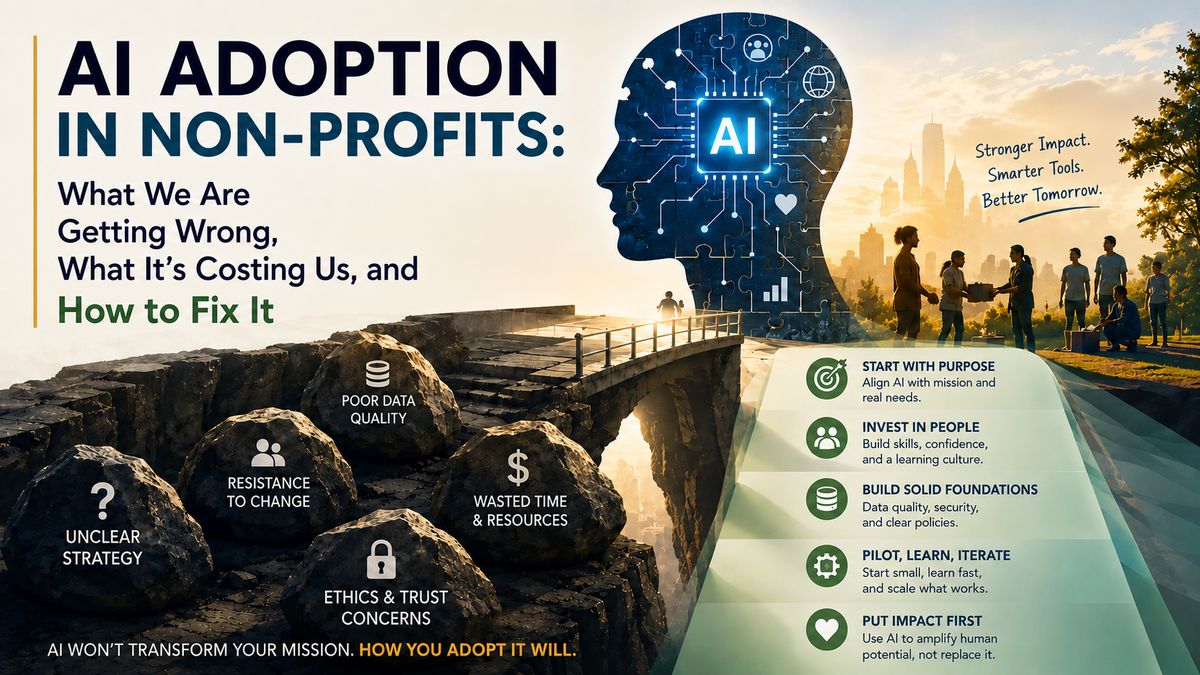
After a few years of being told “AI is the future”, “you need to adopt AI”, “AI first or be left behind”, the good news is that most organisations have gotten the message. 92% of non-profits are using AI in some form 1. But studies are now showing only 7% of those same organisations are reporting that AI has made any real difference in what they can accomplish. The conclusion is obvious: everyone adopted the tools, but they didn’t change how they do their work. That gap between using AI and benefiting from it is where most non-profits are quietly losing ground, and it's worth understanding why, and how to catch up.
What non-profits are actually doing wrong
It's not that non-profits pick the wrong tools, or don’t have the resources, or that AI doesn't work for mission-driven organisations. The problem is simpler than all that; most AI use is happening one person at a time, driven by reaction to a problem and on an ad hoc basis.
The data shows this in two separate ways. First, when you look at how deeply AI is integrated into the organisation, 65% describe their use as reactive and individual, meaning that someone drafts an email or summarises a report on their own initiative, but with no shared process behind it. 18% describe their use on a more operational level, meaning there are shared workflows across teams. Only 7% describe strategic use, meaning the AI is genuinely built into goals, budgets, and priorities.1 Second, on a separate question about whether AI use is written down anywhere at all, 81% of organisations said they use AI individually and on an ad hoc basis; only 4% have documented, repeatable workflows.1 This second finding, the gap between near-universal ad hoc use and almost no documentation, can be considered one of the most significant operational gaps in the sector.
What this looks like day to day is that one staff member figures out a good way to draft personalised donor updates with AI. She never tells the rest of the team. Next month a colleague spends an afternoon solving the same problem. If either of them leaves the organisation, their approach leaves with them, and the next person will have to start all over. Nobody is building on what someone else already knows works. That's the mistake: AI isn’t a personal shortcut; if employees are trained and use cases standardised, it becomes an organisational capability.
There's another related problem that’s important to point out: when there's no shared, sanctioned way to use AI, staff don't necessarily stop using it; they just use it quietly, on their own terms. This pattern is sometimes called "shadow AI," and it means staff and volunteers upload internal documents, or share sensitive information with tools without the organisation knowing.2 It's not malicious. It's what happens by default when there's no clarity on use, and it can be a huge vulnerability.
The risks this creates
Your organisation stays stuck on the efficiency plateau. Organisations that don’t integrate AI usage systemically get faster at the same work: quicker emails, faster first passes at research. That is genuinely useful and frees up employees' time, but it's not the same as gaining actual efficiencies or getting better outcomes. Only 7% of organisations report the kinds of changes that actually impact and improve capacity, like reaching more donors personally or freeing staff time for relationship-building instead of routine tasks.1 Without an adoption framework that is tailored to your organisation's needs and structure, you’ll likely stay on this efficiency plateau.
You're exposed to data privacy risks, and you probably don't know it. Large language models (especially free-tier models) are designed to collect and retain the data users feed into them, sometimes indefinitely, sometimes shared across systems and platforms, to improve the tools themselves.2 Rightfully, non-profits carry confidentiality obligations to donors and grantors as a condition of funding, not to mention confidentiality rules surrounding several different areas, such as health, child safety, and education.2 Once a staff member pastes donor information, a beneficiary's case notes, event details, or grant-restricted data into a public AI tool, your organisation has effectively lost control over where that data goes. None of this is contained, because there's no system-wide policy to contain it: 48% of non-profits have no AI policy at all,1 meaning there's no shared answer to the question: when and how is it appropriate to use AI? Not surprisingly, once organisations move past early experimentation, privacy and security become their top concern, cited by 32% of regular users.) That's not a coincidence. It's what happens when adoption outpaces any organisational policy.
You lose knowledge every time someone leaves. When good AI use lives in each person’s head instead of across shared documents and standardised systems, institutional memory is quickly lost. Team members end up solving the same problems over and over, independently because no one knew a colleague had already solved it and how. New staff, and even existing team members, start from zero instead of building on what already works. For small teams especially, where one person leaving can mean losing 20% of your capacity overnight, this compounds the longer it goes undocumented — it isn't a risk you can get around to solving eventually.
The unexpected data
What is surprising from the data is that you'd expect larger, better-funded organisations to be pulling ahead in this new world, but they’re not. Smaller organisations, those with fewer than 50 staff, report a moderate impact from AI at slightly higher rates than large organisations: 41% versus 34%. They're achieving that while reporting higher rates of every major barrier measured: budget constraints (35% versus 21% for large organisations), privacy and security concerns (32% versus 24%), capability and training gaps (27% versus 18%), and strategy and prioritisation challenges (44% versus 25%).1 On top of all of that, 60% of non-profits overall say that they lack the in-house expertise to even evaluate which AI tools are worth adopting in the first place.3
It’s worth repeating: even though this is one of the hardest times for non-profits in general, and small organisations in particular, it’s the small organisations that are seeing more gains from AI adoption. The report's own conclusion is that organisational complexity, and not lack of resources, appears to be the real barrier to impact.1 Bigger budgets don’t lead to larger gains. Better-resourced organisations often struggle because they have more departments, more approval layers, and more coordination to manage. A five-person team doesn't have that problem. Smaller teams tend to be more nimble and communicate directly with each other about what’s working and how.
If you’re a small or medium non-profit this is good news. It means you’re better placed to capitalise on available tools, and can turn individual experiences into team-wide capabilities without having to allocate more budget.
What you can do
The report lays out six concrete steps you can take to turn AI use into AI adoption and bring real advantages to your organisation. None require technical expertise. None require much time.1
Name a small group to own this. It can be just two or three people alongside their existing roles. Someone close to the day-to-day work, someone from operations or data, and a decision-maker. Their job isn't to become AI experts. It's to keep AI use across the organisation aligned with your mission and your donors' trust.
Decide who's accountable. Make it someone's actual responsibility to evaluate current uses, examine new tools, decide what becomes standard practice and what is not appropriate usage, and revisit that decision periodically. This will avoid having AI use live in each persons head.
Write a one-page use policy. Gather key decision makers and answer key questions about what's encouraged (ex: drafting, research, brainstorming), what needs human review before it is shared (ex: anything donor-facing or public), what's off-limits (confidential data, sensitive donor or beneficiary information), and which platforms/technology is and is not allowed. A document that should be shared with everyone in plain language.
Write down what's already working. Capture the key approaches your team is already using that are showing positive results. Put it somewhere everyone can see and encourage others to add to it.
Match tools to the actual problem. This is a big one I encounter when talking to organisations that want to go AI first. Never just buy the latest tool that everyone is talking about. Determine the real friction points in your organisation, and then look for tools that address those issues specifically. If your organisation needs a more efficient way to track financial gifts, don’t invest in a tool that is designed to optimise customer service communications.
Track one thing for thirty days. Pick a single task, like drafting donor thank-you emails, and time it before and after AI. You don't need sophisticated analytics. You just need one number that tells you whether this is actually saving you and your team time.
Most of these things can be done quickly and give you the information you need to make decisions about how to move forward in a way that works for you, your organisation and your mission.
What you can do this week
If you take one thing from this, let it be that the organisations that are seeing real results from AI are not the ones with the biggest budgets. They're the ones who stopped treating AI as something individual staff figure out on their own, and started adopting it as an organisational tool that could be deployed evenly and consistently across the organisation.
If you’re eager to take advantage of AI but aren’t sure how it could work for your team, what you can do this week is:
Pick two or three people, even informally for now, to be responsible for how your organisation approaches AI.
Ask your team what AI approaches already work for them, write then down, share them.
Block time to write a one-page policy answering: what's encouraged, what needs review, and what's prohibited, including a clear line on tools, and confidential and donor data.
Choose one task to track to see if time is saved over the next month.
You already have what you need to make AI serve your mission. You can easily start today.
Key References
The 2026 Nonprofit AI Adoption Report, Virtuous and Fundraising.AI, a benchmark study of 346 non-profit organisations surveyed in December 2025, published February 2026. Full report: virtuous.org/resource/the-2026-nonprofit-ai-adoption-report-download
SecureAZ, "Responsible AI: Security and Privacy Tips for Nonprofits," published via the ASU Lodestar Center for Philanthropy and Nonprofit Innovation, April 2026. lodestar.asu.edu/blog/2026/04/responsible-ai-security-and-privacy-tips-nonprofits
UST, "The Impact of AI on Nonprofits in 2026," April 2026. chooseust.org/blog/the-impact-of-ai-on-nonprofits-in-2026. UST attributes its data to the Virtuous/Fundraising.AI report above and to Nonprofit Tech for Good's 2025 AI Equity Report; this specific figure likely originates from the latter.