Nonprofit Builder Blog

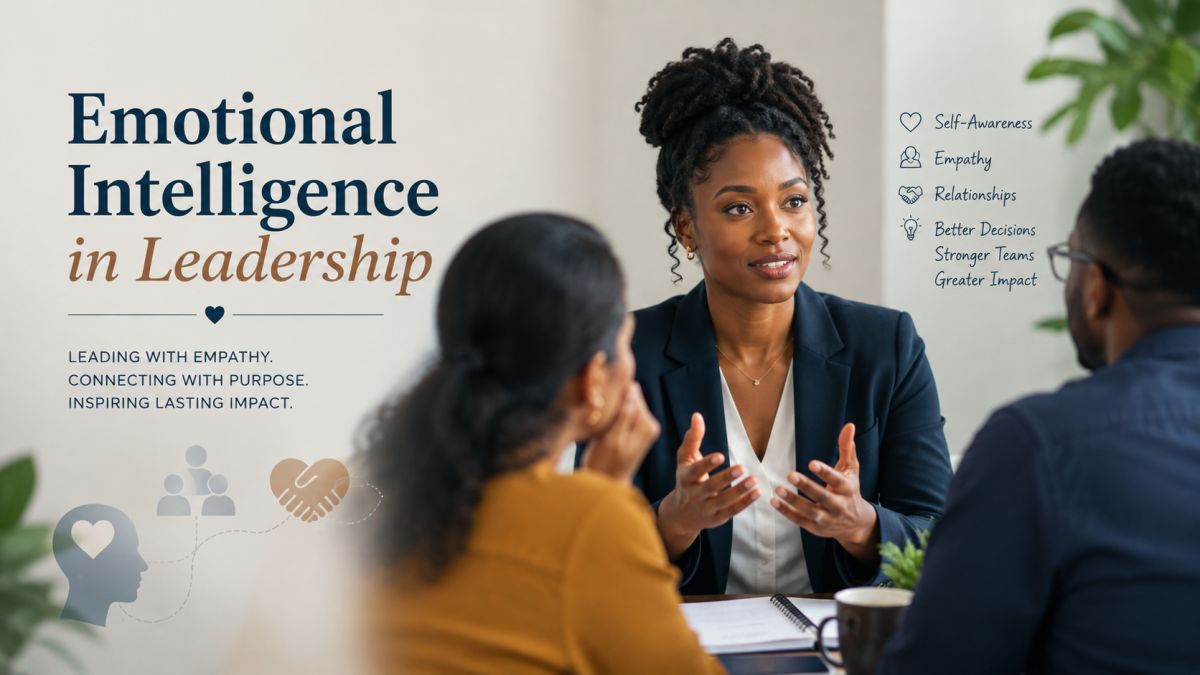
Emotional Intelligence in Leadership

Emotional Intelligence in Leadership "Emotional intelligence is the ability to perceive, understand, and influence our own and others' emotions, across a range of contexts, to guide our current thinking and actions, to help us achieve our goals." – Dr. Cliff Lansley Leadership is not about shouting orders or drafting brilliant strategies alone. It's also about understanding people. Great leaders know the temperature of the room, read both verbal and non-verbal cues, and guide their teams toward a shared goal without losing sight of individual motivations. That's precisely where emotional intelligence (EI) comes in. Why Emotional Intelligence Matters for Leaders While IQ might get you through the door, your EQ helps you climb the ladder. Emotional intelligence plays a pivotal role in both personal and professional settings. For leaders, high EI results in better team dynamics, increased morale, and higher productivity. It enables leaders to inspire trust, resolve conflicts more effectively, and guide their teams through challenges with empathy and understanding. Dr. Cliff Lansley argues that EI is fundamentally about abilities, not personality traits. He identifies 12 core competencies, organized under self-awareness, self-management, social awareness, and social interaction, as the measurable backbone of EI. When honed, these competencies form the bedrock of effective leadership. Leaders who build them tend to: Self-regulate – keeping their own emotional reactions in check and avoiding knee-jerk decisions. Show empathy – sensing the emotional climate in a room and using that insight constructively. Communicate clearly – proactively addressing issues so rumor or speculation doesn't define the narrative. Motivate – tapping into each team member's inner drive and aligning personal ambitions with the organization's goals. Any leader who neglects these competencies risks plunging themselves and their team into chaos. Putting Emotional Intelligence Into Practice Understanding the competencies is one thing; applying them is another. A few practical starting points: Understand your team. Align individual goals with the organization's mission. Hiring people who resonate with your values reduces friction and fosters cohesion. Foster psychological safety. Organizational behavior researcher Amy Edmondson's research on teaming shows that people perform best when they feel safe to speak up. Building a culture of open communication and respect is not a nice-to-have, it's a performance driver. Stay adaptable. Great leaders read the room, anticipate emotional triggers, and pivot when necessary. Flexibility and resilience are key. How to Build Your Emotional Intelligence Unlike IQ, which is relatively fixed, anyone can cultivate their emotional intelligence. A few ways to strengthen it: Mindfulness practice – paying attention to your emotions without judgment builds self-awareness. Seeking feedback – especially in professional settings, feedback offers valuable insight into how your emotions land on those around you. Empathy training – actively working to understand others' emotions and perspectives strengthens social awareness and relationship management. Stress management – managing stress is vital to controlling emotional responses and staying level-headed under pressure. Why This Matters in the Nonprofit and Capacity Building Space For the grantees, consultants, and organizations we work with at Nonprofit Builder, emotional intelligence is not an abstract leadership ideal, it shows up daily. It's in how a program lead navigates a difficult funder conversation, how a consultant reads a grantee's unspoken concerns during a proposal discussion, and how teams under resource pressure stay aligned rather than fractured. Strengthening EI is, in many ways, strengthening organizational resilience. Whether you're leading a global company or a small nonprofit, the message is clear: emotional intelligence isn't optional, it's essential. It's the glue that binds teams, the force that drives performance, and the shield that protects against internal discord and external pressure. As the saying goes, people may forget a bad decision or a losing streak, but they rarely forget how a leader made them feel. That's emotional intelligence in a nutshell. Looking to strengthen leadership and team capacity within your organization? [Explore how Nonprofit Builder connects grantees with vetted consultants] who can support this work.

25 Aug, 2026 09:00 Read more

The Nonprofit's Guide to Securing Platforms You Don't Control

The Nonprofit's Guide to Securing Platforms You Don't Control When Elon Musk took over Twitter, he wanted to rename the company “X.” But someone else already had that handle and had been using it for years. This was not a problem for Elon. He owned the company, and he owned all the accounts. So he just took it. It's a strange, small story, but it points to something bigger: most of what we consider "ours" online, we don't actually own. We rent it. And the terms of that lease, including who gets access and how it's protected, can change without our consent. In the nonprofit sector, you live this reality every day, often without time to think about its implications. Your donor CRM, your email, your Facebook page, your Google Drive full of case files: almost none of it lives on infrastructure you control. That's not necessarily a problem. Free and low-cost platforms are often the only way small nonprofits can operate at all. But your security posture needs to plan for the fact that a vendor, not your organization, controls the platforms your mission depends on. You can't control everything, but protecting your mission starts with what you can control . Here’s how. Know what people use Ask most nonprofit leaders how many digital tools their organization uses, and you'll get a rough guess. Ask which specific platforms every staff member and volunteer actually has an account on, and the guess gets a lot rougher. That gap is a security risk in itself. Small nonprofits rarely have a formal IT approval process. Someone needs to share files, so they set up a personal Dropbox. Someone needs a quick way to survey volunteers, so they sign up for a free tool with their work email. None of it is malicious, and often it solves a real problem in the moment. But every one of those accounts is a place where your organization's data now lives, outside of anything you're tracking or securing. Start with a simple inventory: what platforms does your staff actually use to do their jobs, including the platforms nobody officially approved? A short survey or a five-minute conversation with each team member is usually enough to surface tools you didn't know existed. You're not trying to catch anyone doing something wrong; you're trying to find out where your mission's data actually lives, so you can decide what belongs there and what doesn't. Read the Terms of Service If a breach is really about unwanted access to your data, then the fine print you (or individual team members) agreed to without reading is already part of that equation. Every platform you use has a Terms of Service and a Privacy Policy, and buried in that fine print are the actual rules of the relationship: what the platform can do with your data, whether they can sell or share it with third parties, and what happens to your information if you stop paying or the company changes hands. For a nonprofit holding sensitive constituent data, case files, or donor information, those answers matter as much as any firewall. This risk goes up sharply with free tools. There's an old saying in tech: if you're not paying for the product, you are the product. Free platforms often make up the difference by monetizing user data, and "monetizing" can mean selling it, using it to train other products, or sharing it with advertisers and partners in ways you never explicitly agreed to. That doesn't mean you should stop using free tools; for many nonprofits, they're the only option. But it does mean you should know, going in, what the trade-off actually is. The problem, of course, is that Terms of Service documents are written to be skimmed past, not understood. They're long, dense, and full of legal language that obscures more than it reveals. This is a place where AI tools can genuinely help: you can paste a platform's Terms of Service or Privacy Policy into a tool and ask it to summarize, in plain language, what happens to your data, whether it can be sold, and what your rights are if you want it deleted. It won't replace legal advice, but it can turn an hour of dense reading into a five-minute gut check, which is often the difference between checking at all and not checking. Know exactly who holds the keys Unlike large companies with dedicated IT departments, nonprofits often rely on a revolving cast of staff, interns, and volunteers. As a result, access and login controls are spread across a number of staff members. Every person who's ever had a login to your donor database or social accounts is a potential access point. Keep a living list of who has access to what and when their access needs were last reviewed. If you can't produce that list in five minutes, that's your first project. Then, build an offboarding checklist that is utilized every time. When someone leaves, their access should leave with them. Revoke email, remove from Slack, pull CRM permissions, rotate any shared passwords they knew. This single habit closes one of the most common security gaps in small organizations. This is another reason to have a complete list of the software team members use. If someone is storing work files under an account they set up, then you can lose access to it when they leave. Don’t trust default settings The free and discounted tools nonprofits rely on often have weaker default security and slower support than their enterprise versions. That's often a necessary trade-off for being able to do your work, but it means basic protections, like MFA, access review, and login alerts, are your responsibility, not the platform's. Check what security features your tools offer and whether they're actually turned on. Defaults are rarely the safest setting. Where applicable, consider upgrading your more sensitive systems to a paid plan if it gives you a higher level of security. Take ownership back with backups You can't own the platform, but you can own a copy of what's on it. Regular, tested backups of donor records, financials, and program data mean that if you get locked out of a platform, or even if it simply goes down, your mission's history doesn't go down with it. This is also an essential protection from ransomware attacks and malicious deletions from hacked accounts. Be sure to test your backups on a regular schedule. “ A backup never tested is a hope, not a plan. " Ensure that any manual procedures are being followed and that any automated systems are not experiencing sync errors. You don’t want to find out after a ransomware attack that the backups you thought you had do not actually exist. Have a response plan Backup procedures, offboarding checklists, and regular settings reviews illustrate how digital security is as much about policies as it is about technology. You need to act as if eventually something will go sideways: a hacked account, a platform error, or a departed staffer who was the only one with the password. An incident response plan can help keep you accountable to take proactive steps to prevent a security issue and take quick and decisive action if something does happen. Decide now, not during the emergency, who has authority to work with the platform's support team, where your backup contact information lives, and how you'll communicate with your community if a channel goes dark temporarily. If you don’t have an incident response plan, our team can help you develop one. None of this means you should stop using cloud technologies and go back to paper forms and filing cabinets. Apart from the fact that that’s practically impossible today, these tools do help you work better. They help keep you connected with your team and your constituents. They improve service delivery, increase fundraising, and add efficiencies that save you money. But building on rented land comes with risks you need to consider. It means knowing what you can’t control, controlling what you can, and taking proactive steps to ensure your mission's memory doesn't live in only one place. Sources ● IBM, Cost of a Data Breach Report 2025 ● FBI Internet Crime Complaint Center (IC3), 2025 Internet Crime Report ● RipRap Security, Nonprofit Data Breaches & Their Impact ● VikingCloud, Cybersecurity Statistics 2026 ● Cal Nonprofits Insurance Services, Cyber Liability Risks Every Nonprofit Faces in 2026 ● Nten Cybersecurity for Nonprofit guide Amber Crayton Associate Cybersecurity Consultant Undaunted Consulting she/her Amber is a self-motivated and detail-oriented cybersecurity professional bringing over four years of hands-on experience in cybersecurity and over seven years in customer service. With strong problem-solving skills, she focuses on troubleshooting technical and security issues. She has a strong foundation in risk assessment, digital privacy, and network security. With a background in both public and private sectors, Amber has worked across diverse IT environments performing system audits, evaluating security protocols, and supporting data protection initiatives. Her expertise includes conducting vulnerability assessments to identify and mitigate risks, supporting secure system configurations, and managing sensitive information through strong compliance practices. Amber is also skilled in implementing secure file handling protocols, auditing embedded systems, and assisting with phishing simulations and user awareness training to improve organizational resilience. She is passionate about translating technical concepts for non-technical stakeholders, improving end-user security behaviors, and enhancing privacy in AI-integrated environments. With a Bachelor’s Degree in Applied Technology: Cybersecurity, Amber holds the CompTIA Security+ (SY0-701) certification and a level one CISSP certificate, as well as a Cybersecurity Infrastructure Technician certificate. Her proactive mindset, attention to detail, and ability to foster collaboration make her an asset to the Undaunted team and its clients. Amber is committed to continuous learning and brings ethical judgment, strategic thinking, and a detail-oriented mindset to every engagement. To learn more about Amber and Undaunted Consulting, reach out to hello@undaunted.llc or visit www.undaunted.llc .

20 Aug, 2026 10:34 Read more

Outcome Harvesting: Simple in Principle, Challenging in Practice

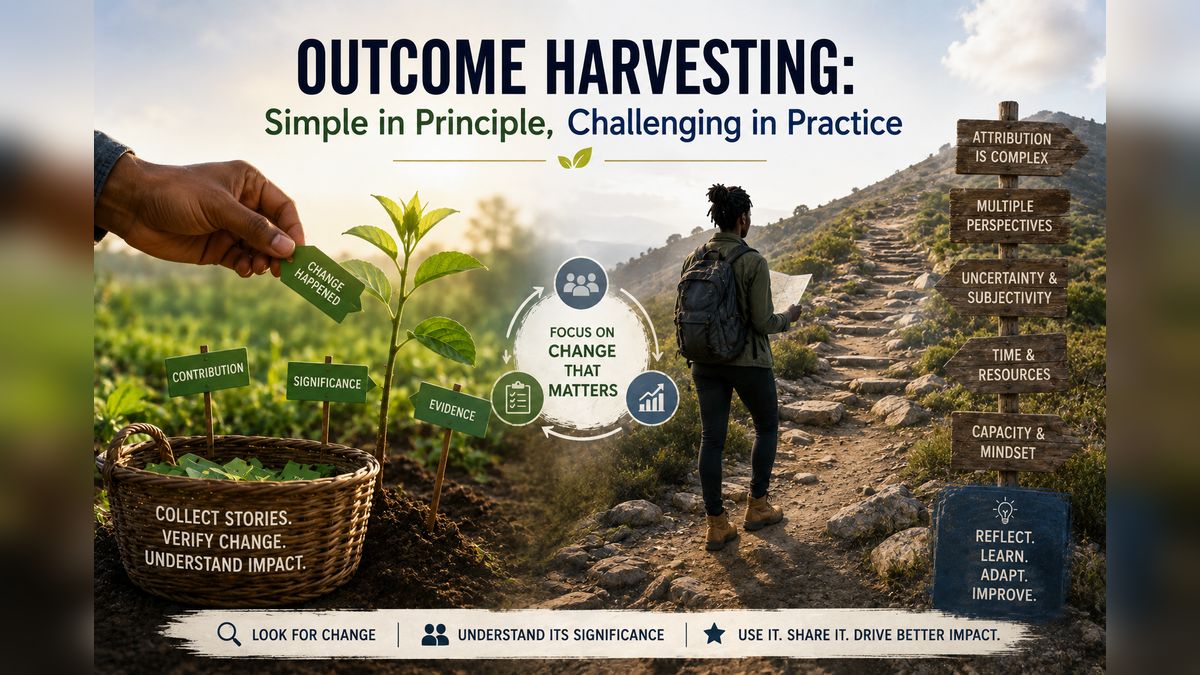
For the past decade, Outcome Harvesting has been a favoured choice of methodology for many organisations seeking to strengthen the governance of their work and use lessons learnt in their strategic planning. This is hardly surprising. Outcome Harvesting is a method for monitoring and evaluation that is conceptually straightforward at a first glance. Yet formulating, analysing and learning from outcomes – and using it for governance and strategic planning – requires considerable discipline. This article discusses some of the main challenges associated with Outcome Harvesting and what organisations applying the approach may do to overcome them to improve program governance and evidence-based strategic planning. Malene Sønderskov, Evaluation Expert Outcome Harvesting has gained significant popularity as an approach to monitor and govern programmatic work since Ricardo Wilson Grau and Heather Britt first introduced and described it in a guide called ‘Outcome Harvesting’, published by the Ford Foundation in May 2012. Wilson Grau later explained the approach at length in a book from 2018 called ‘Outcome Harvesting, principles, steps and evaluation application’. Its popularity is hardly surprising. With time, more development interventions have moved from responding to immediate needs to addressing the multiple factors and actors that cause poverty and human suffering; often in causal pathways of change that are unpredictable and far from the causality that can be predicted in a vaccine program that aims to reduce morbidity or a school program that promotes learning. Outcome Harvesting has become popular because it fits the realities of complex programmes better than many traditional monitoring approaches. Its main attraction is that it starts with what has changed, rather than only checking progress against predetermined indicators - which might turn out to be of little relevance in a programme where constant change is the only predictable factor. Consequently, Outcome Harvesting is especially useful in advocacy, governance, women’s rights, peacebuilding and systems-change programmes, where outcomes are indeed unpredictable and usually the result of several actors and factors, of which the intervention itself is only one. Yet Outcome Harvesting may also be attractive for other reasons. Unlike more traditional – and quantitative – approaches, Outcome Harvesting can be applied without baseline data and with limited or no concern for control groups, sampling strategies and calculation of the data set’s statistical significance. A tempting choice, if time and resources for data collection are scarce and no one has time to design or introduce a monitoring and data collection design already at the onset of the intervention. Yet lessons learnt from organisations applying Outcome Harvesting suggests that – as with many other things in life – the devil is to be found in the details, and that Outcome Harvesting might not be as straight forward and simple as we think. This article presents some of the challenges that we have encountered facilitating Outcome Harvesting processes with organisations all over the world. The article concludes with some recommendations or points to observe to get the full benefit of an Outcome Harvesting exercise. Language matters Ricardo Wilson Grau’s writings about Outcome Harvesting clearly define an outcome as a change in the behaviour, relationships, actions, activities, policies, or practices of an individual, group, community, organisation, or institution. Based on this definition, it should therefore not be straightforward to identify and formulate outcomes. In practice, formulating outcomes can be harder than one imagines, and participants in Outcome Harvesting exercises often express uncertainty about whether their statements genuinely describe change. One reason may lie in the language commonly used in development work. When planning interventions and describing our work, we often rely on passive constructions, abstract concepts, and broad terms such as empowerment, resilience, and capacity building. Although these terms may sound important—and may align well with donor priorities—they often reveal very little about who has changed, what these actors do differently, and why that change matters. To formulate and harvest outcomes, we therefore need to switch to another kind of language — or even unlearn some of the language we have been socialised to use when we talk about development work. Fortunately, the language we need to harvest outcomes resembles the language we were taught in school grammar lessons. A proper sentence, we learned, includes a subject, a verb and an object. With these three elements, we can construct a sentence that tells us who changed and what changed. This matters. If we cannot clearly say who changed what, it becomes very difficult to analyse whether change happened — and why. A useful guiding rule is therefore to limit each outcome statement to one sentence. Clear and concise language is not a simplification of complexity. It is a precondition for understanding it. Our expectations blur the vision Our expectations and perceptions about what change looks like and how fast it takes place may be another reason why formulating outcomes can be difficult. A quick look at the objectives of many development interventions reveals that ambitions are often huge. Gender equality, reconciliation between conflicting groups, food security for communities affected by hunger. The list of hopeful and ambitious aims to be achieved within a relatively short period of time is often long. When we engage in Outcome Harvesting, it is therefore hardly surprising if we tend to look for major, visible results and forget that change very often takes time and includes periods of stalemate or even regression. Yet European history proves the point: Equality between men and women, equal rights for sexual minorities, abolition of death penalty, and proper care for people with mental diseases has not materialised overnight in any country, and despite important achievements, inequality persists. Even in the most ‘advanced’ countries. Rather than expecting and looking for quick and visible changes, it is important to remember that change is often incremental and becomes apparent through everyday decisions, interactions between people, changes of practices and behaviours. Formulating a clear outcome therefore requires us to look closely at what people or institutions are doing differently, rather than describing general aspirations, activities or desirable conditions that it may take years – or even decades – to achieve. If Outcome Harvesting is the answer – what was then the question? Outcome Harvesting collects (“harvests”) evidence of what has changed (“outcomes”) and, working backwards, determines whether and how an intervention has contributed to these changes. When organisations harvest outcomes, the result is often a long list of ‘change stories’–frequently collected and organised in an outcome database that staff and other interested stakeholders can consult, if they wish to access information about the performance of their program. Unfortunately, this treasure of information (outcomes) gathered is often left partly or fully unexplored, however. One reason is that organisations may struggle to find the time and resources needed to make sense of all the outcomes they have collected. This includes exploring whether the outcomes reveal a pattern, whether some outcomes lead to others further along a change pathway, and whether the outcomes produced align with the outcomes originally expected. Another reason may be that insufficient attention is paid to the purpose of the Outcome Harvesting exercise. While Outcome Harvesting may be “the answer” to many organisations’ need for monitoring data, organisations sometimes forget to ask themselves what the question was: What is it that they, as organisations, programme practitioners or MEL staff, want to know about their programme — beyond whether or not it produced outcomes? Outcome Harvesting offers a unique opportunity for learning and strategic adjustment, but only if we invest the time and resources needed to analyse the full sample of outcomes harvested. This requires us to begin the entire Outcome Harvesting exercise by formulating clear questions that can guide the process. Key questions to consider when analysing outcomes include – but may not be limited to: What outcomes did we produce? Do the outcomes we have produced fall into certain categories (e.g. policy changes, institutional changes, behaviour changes or changes in relations). Are we producing more outcomes in some categories than in others? If so, what may be the reason? To what extent are the outcomes harvested aligned with outcomes that we expected to produce/contribute to when we formulated our program? To what extent and how are outcomes connected in causal pathways? What other factors and actors have contributed to the outcomes we are harvesting – and to the links between them? And last, but not least: What do these insights tell us about how and under which circumstances change happens? And what are the implications for our program that we can draw from this? If we forget to ask questions that can guide analytical reflection, then we risk not capitalising on the richness of the outcomes that we have harvested. The key recommendations for Outcome Harvesting as a means to strengthen program governance So where does that leave organisations who adopt Outcome Harvesting as a means to understand the contributions they make in contexts of complexity and who wants to invest in their ability to make sense of their results to better govern programs and ensure that new strategies are informed by evidence and lessons learnt? Below are ten recommendations that might assist in making much more out of the Outcome Harvesting process. Planning the harvest and formulating outcomes Begin with learning questions. Before collecting outcomes, decide what your organisation wants to understand. Outcome Harvesting should not merely produce a database of change stories; it should generate evidence that answers strategic questions about your program. Formulate each outcome as one clear, concrete sentence. Use a subject, verb, and object to state who changed, what they now do differently and, where relevant, why the change matters. Clear and concise outcome statements are easier to verify, compare and analyse. Look for incremental change. Do not focus only on major policy reforms or highly visible results. Changes in everyday behaviour, relationships, decisions and practices may be important steps in a longer pathway of change. Separate outcomes from activities and aspirations. Training people, holding meetings or producing a guide are activities. Gender equality, reconciliation and food security are broad ambitions. The outcome is the change in what a specific actor does as a result. Harvest only what the organisation has capacity to analyse. A smaller, well-analysed set of outcomes is more useful than a large collection that remains unexplored. Analysing outcomes Analyse patterns across outcomes. Examine if outcomes cluster around particular actors, levels or types of change, and whether some kinds of outcomes appear more frequently than others. Compare harvested outcomes with the programme’s theory of change. Assess if the changes align with what the programme expected, whether unexpected pathways have emerged, and whether the original assumptions about how change happens remain credible. Explore connections between outcomes. Individual outcomes should not always be treated as isolated stories. Investigate whether one change enabled or reinforced another. Examine contribution, not only occurrence. Consider how the intervention contributed, but also identify the other actors, contextual factors, and events that helped or hindered change. Use findings to adjust strategy and planning. Translate lessons about how change happens into revisions of activities, partnerships, priorities and theories of change.

17 Aug, 2026 16:53 Read more

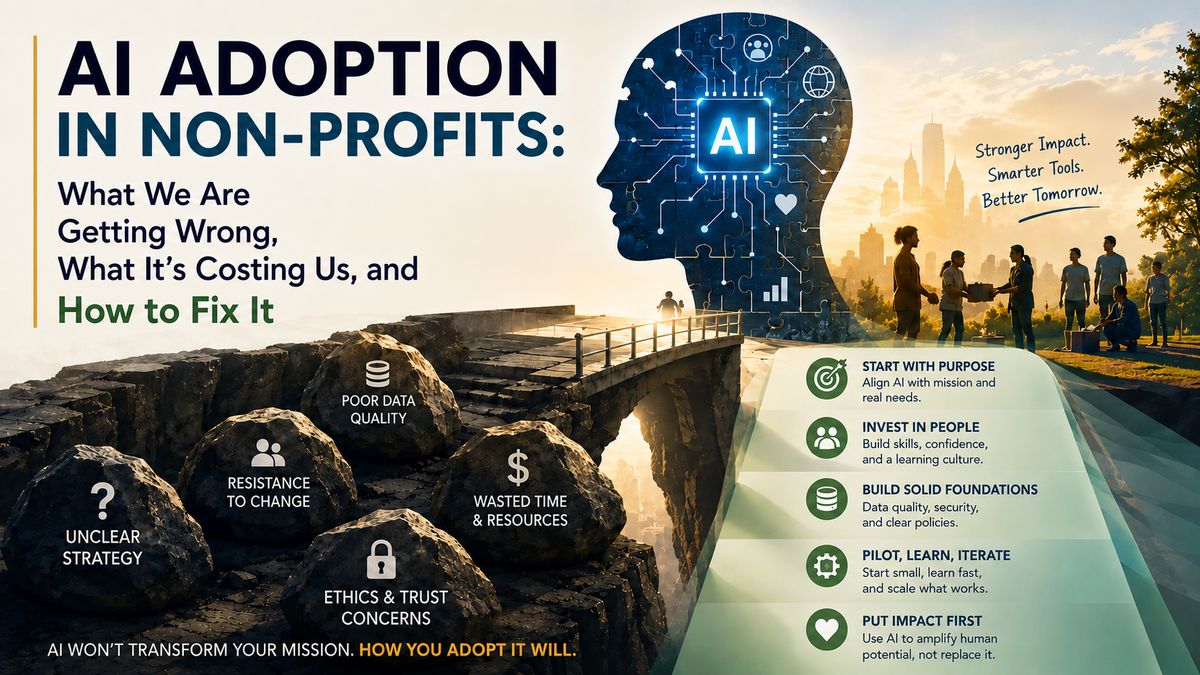
AI Adoption in Non-Profits: What We Are Getting Wrong, What It's Costing Us, and How to Fix It

By SBSeen After a few years of being told “AI is the future”, “you need to adopt AI”, “AI first or be left behind”, the good news is that most organisations have gotten the message. 92% of non-profits are using AI in some form 1 . But studies are now showing only 7% of those same organisations are reporting that AI has made any real difference in what they can accomplish. The conclusion is obvious: everyone adopted the tools, but they didn’t change how they do their work. That gap between using AI and benefiting from it is where most non-profits are quietly losing ground, and it's worth understanding why, and how to catch up. What non-profits are actually doing wrong It's not that non-profits pick the wrong tools, or don’t have the resources, or that AI doesn't work for mission-driven organisations. The problem is simpler than all that; most AI use is happening one person at a time, driven by reaction to a problem and on an ad hoc basis. The data shows this in two separate ways. First, when you look at how deeply AI is integrated into the organisation, 65% describe their use as reactive and individual, meaning that someone drafts an email or summarises a report on their own initiative, but with no shared process behind it. 18% describe their use on a more operational level, meaning there are shared workflows across teams. Only 7% describe strategic use, meaning the AI is genuinely built into goals, budgets, and priorities. 1 Second, on a separate question about whether AI use is written down anywhere at all, 81% of organisations said they use AI individually and on an ad hoc basis; only 4% have documented, repeatable workflows. 1 This second finding, the gap between near-universal ad hoc use and almost no documentation, can be considered one of the most significant operational gaps in the sector. What this looks like day to day is that one staff member figures out a good way to draft personalised donor updates with AI. She never tells the rest of the team. Next month a colleague spends an afternoon solving the same problem. If either of them leaves the organisation, their approach leaves with them, and the next person will have to start all over. Nobody is building on what someone else already knows works. That's the mistake: AI isn’t a personal shortcut; if employees are trained and use cases standardised, it becomes an organisational capability. There's another related problem that’s important to point out: when there's no shared, sanctioned way to use AI, staff don't necessarily stop using it; they just use it quietly, on their own terms. This pattern is sometimes called "shadow AI," and it means staff and volunteers upload internal documents, or share sensitive information with tools without the organisation knowing. 2 It's not malicious. It's what happens by default when there's no clarity on use, and it can be a huge vulnerability. The risks this creates Your organisation stays stuck on the efficiency plateau. Organisations that don’t integrate AI usage systemically get faster at the same work: quicker emails, faster first passes at research. That is genuinely useful and frees up employees' time, but it's not the same as gaining actual efficiencies or getting better outcomes. Only 7% of organisations report the kinds of changes that actually impact and improve capacity, like reaching more donors personally or freeing staff time for relationship-building instead of routine tasks. 1 Without an adoption framework that is tailored to your organisation's needs and structure, you’ll likely stay on this efficiency plateau. You're exposed to data privacy risks, and you probably don't know it. Large language models (especially free-tier models) are designed to collect and retain the data users feed into them, sometimes indefinitely, sometimes shared across systems and platforms, to improve the tools themselves. 2 Rightfully, non-profits carry confidentiality obligations to donors and grantors as a condition of funding, not to mention confidentiality rules surrounding several different areas, such as health, child safety, and education. 2 Once a staff member pastes donor information, a beneficiary's case notes, event details, or grant-restricted data into a public AI tool, your organisation has effectively lost control over where that data goes. None of this is contained, because there's no system-wide policy to contain it: 48% of non-profits have no AI policy at all, 1 meaning there's no shared answer to the question: when and how is it appropriate to use AI? Not surprisingly, once organisations move past early experimentation, privacy and security become their top concern, cited by 32% of regular users. ) That's not a coincidence. It's what happens when adoption outpaces any organisational policy. You lose knowledge every time someone leaves. When good AI use lives in each person’s head instead of across shared documents and standardised systems, institutional memory is quickly lost. Team members end up solving the same problems over and over, independently because no one knew a colleague had already solved it and how. New staff, and even existing team members, start from zero instead of building on what already works. For small teams especially, where one person leaving can mean losing 20% of your capacity overnight, this compounds the longer it goes undocumented — it isn't a risk you can get around to solving eventually. The unexpected data What is surprising from the data is that you'd expect larger, better-funded organisations to be pulling ahead in this new world, but they’re not. Smaller organisations, those with fewer than 50 staff, report a moderate impact from AI at slightly higher rates than large organisations: 41% versus 34%. They're achieving that while reporting higher rates of every major barrier measured: budget constraints (35% versus 21% for large organisations), privacy and security concerns (32% versus 24%), capability and training gaps (27% versus 18%), and strategy and prioritisation challenges (44% versus 25%). 1 On top of all of that, 60% of non-profits overall say that they lack the in-house expertise to even evaluate which AI tools are worth adopting in the first place. 3 It’s worth repeating: even though this is one of the hardest times for non-profits in general, and small organisations in particular, it’s the small organisations that are seeing more gains from AI adoption. The report's own conclusion is that organisational complexity, and not lack of resources, appears to be the real barrier to impact. 1 Bigger budgets don’t lead to larger gains. Better-resourced organisations often struggle because they have more departments, more approval layers, and more coordination to manage. A five-person team doesn't have that problem. Smaller teams tend to be more nimble and communicate directly with each other about what’s working and how. If you’re a small or medium non-profit this is good news. It means you’re better placed to capitalise on available tools, and can turn individual experiences into team-wide capabilities without having to allocate more budget. What you can do The report lays out six concrete steps you can take to turn AI use into AI adoption and bring real advantages to your organisation. None require technical expertise. None require much time. 1 Name a small group to own this . It can be just two or three people alongside their existing roles. Someone close to the day-to-day work, someone from operations or data, and a decision-maker. Their job isn't to become AI experts. It's to keep AI use across the organisation aligned with your mission and your donors' trust. Decide who's accountable . Make it someone's actual responsibility to evaluate current uses, examine new tools, decide what becomes standard practice and what is not appropriate usage, and revisit that decision periodically. This will avoid having AI use live in each persons head. Write a one-page use policy. Gather key decision makers and answer key questions about what's encouraged (ex: drafting, research, brainstorming), what needs human review before it is shared (ex: anything donor-facing or public), what's off-limits (confidential data, sensitive donor or beneficiary information), and which platforms/technology is and is not allowed. A document that should be shared with everyone in plain language. Write down what's already working. Capture the key approaches your team is already using that are showing positive results. Put it somewhere everyone can see and encourage others to add to it. Match tools to the actual problem . This is a big one I encounter when talking to organisations that want to go AI first. Never just buy the latest tool that everyone is talking about. Determine the real friction points in your organisation, and then look for tools that address those issues specifically. If your organisation needs a more efficient way to track financial gifts, don’t invest in a tool that is designed to optimise customer service communications. Track one thing for thirty days. Pick a single task, like drafting donor thank-you emails, and time it before and after AI. You don't need sophisticated analytics. You just need one number that tells you whether this is actually saving you and your team time. Most of these things can be done quickly and give you the information you need to make decisions about how to move forward in a way that works for you, your organisation and your mission. What you can do this week If you take one thing from this, let it be that the organisations that are seeing real results from AI are not the ones with the biggest budgets. They're the ones who stopped treating AI as something individual staff figure out on their own, and started adopting it as an organisational tool that could be deployed evenly and consistently across the organisation. If you’re eager to take advantage of AI but aren’t sure how it could work for your team, what you can do this week is: Pick two or three people, even informally for now, to be responsible for how your organisation approaches AI. Ask your team what AI approaches already work for them, write then down, share them. Block time to write a one-page policy answering: what's encouraged, what needs review, and what's prohibited, including a clear line on tools, and confidential and donor data. Choose one task to track to see if time is saved over the next month. You already have what you need to make AI serve your mission. You can easily start today. Key References The 2026 Nonprofit AI Adoption Report, Virtuous and Fundraising.AI , a benchmark study of 346 non-profit organisations surveyed in December 2025, published February 2026. Full report: virtuous.org/resource/the-2026-nonprofit-ai-adoption-report-download SecureAZ, "Responsible AI: Security and Privacy Tips for Nonprofits," published via the ASU Lodestar Center for Philanthropy and Nonprofit Innovation, April 2026. lodestar.asu.edu/blog/2026/04/responsible-ai-security-and-privacy-tips-nonprofits UST, "The Impact of AI on Nonprofits in 2026," April 2026. chooseust.org/blog/the-impact-of-ai-on-nonprofits-in-2026. UST attributes its data to the Virtuous/ Fundraising.AI report above and to Nonprofit Tech for Good's 2025 AI Equity Report; this specific figure likely originates from the latter.

13 Aug, 2026 08:58 Read more

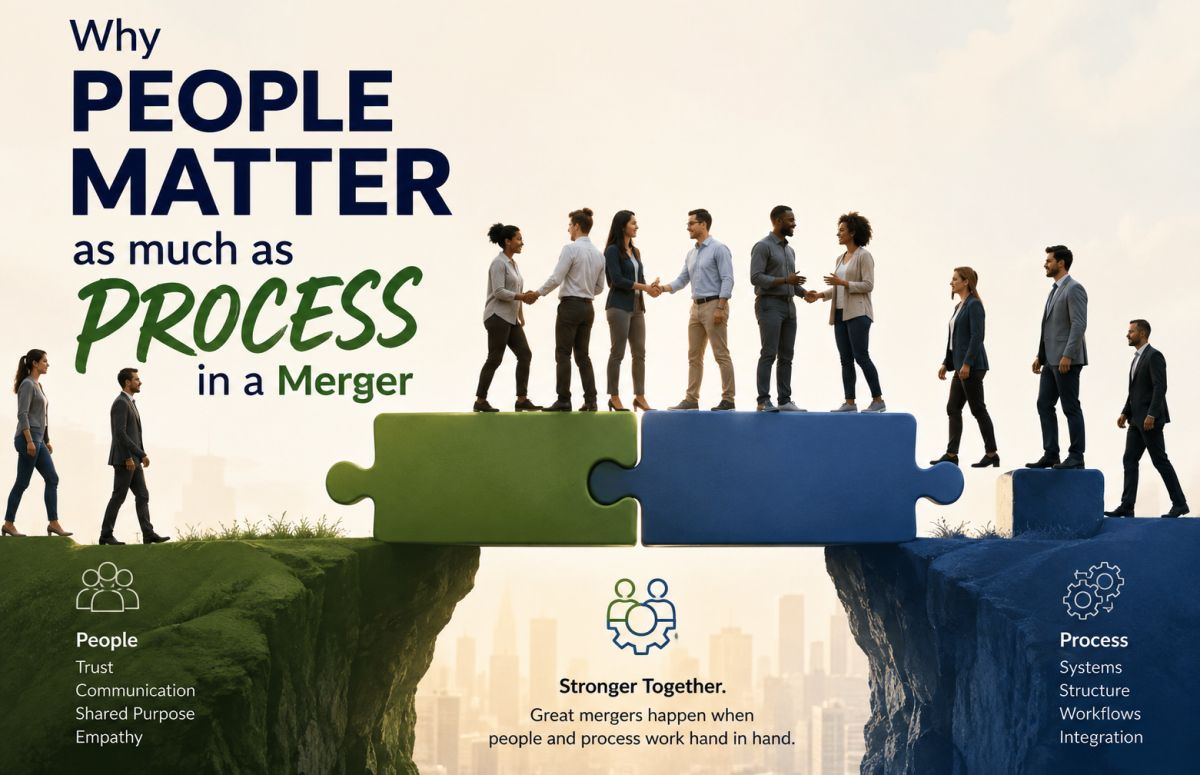
Why People Matter as Much as Process in a Merger

Why People Matter as Much as Process in a Merger Every merger comes with a strategy deck, a budget, and an integration plan; all built around people, but too often not built for them. Our work supporting Girl Rising through its merger with She’s the First, alongside our own experience merging Global Good Consulting and the Amani Institute, led us to a simple yet critical insight: A merger doesn’t only succeed because systems integrate. It succeeds because people do. The Part We Don’t Talk About Enough On paper, mergers are rational. In practice, they are deeply human. Mergers surface questions that rarely make it into integration plans: Where do I fit into the new structure? Will my voice matter? What happens to the culture I helped build? Who are we becoming—and do I belong in that future? These questions don’t just sit in the background, they shape how professionals show up in the workplace - with energy and shared values, or with hesitation and resistance. That reality became particularly clear throughout the Girl Rising and She’s the First merger. Progress wasn't only about strategy or capability. It came down to how people experienced the transition, whether they felt seen, heard, and valued. Girl Rising's leadership recognized the importance of creating space for people to contribute, ask questions, and have their voices heard. Read more about their perspective here . Trust is the Framework that Holds it All Together What became clear, both in our client work and in our own merger, was that success rests on trust. The same way that we prioritize a strategic plan for the business, we need to develop and prioritize a plan to build trust so that the merger is effective. Trust is built intentionally over time through people-centered practices. For us, that looked like simple but not easy practices: Make room for real conversations Not just sharing updates, but creating space for honest dialogue where colleagues can voice concerns, name tensions, and feel heard. Be clear about what’s changing—and what’s not Clarity reduces anxiety. It also reinforces continuity. Prioritize alignment Clarity on roles is important, but it’s not enough. What matters more is shared purpose, expectations, values, and ways of working. Support people as individuals Change doesn’t only happen at the organizational level; it also happens at an individual level. Coaching, mentoring, and structured reflection help people process what is shifting, and work out where they fit in what comes next. It also signals that the organization is investing in them, as valued members of its future. And it tells them something concrete: the organization is still betting on their future, not just managing their transition. Walk the Talk in Our Own Merger When we came together as Global Good x Amani, we had the tools (strategy, systems thinking, and organizational design). Yet what mattered most was how we showed up for each other. We learned that: Alignment is not a one-time event, it’s an ongoing practice Culture cannot be merged through documents, it must be co-created Silence is rarely neutral, it often signals a topic that needs attention Slowing down to bring people along ultimately allows the merged entity to go further with a united front Some of the most critical moments in our merger looked like conversations, reflection spaces, and navigating tension with care. What This Means for Organizations Navigating Change Whether it’s a merger, a restructuring, or a period of growth, the pattern is the same: Organizations that focus heavily on systems at the expense of people may move quickly, but struggle to sustain momentum long term. Organizations that invest in their people are able to build the trust that is needed to navigate change together.. Because: When colleagues feel included, they contribute. When colleagues feel heard, they engage. When colleagues feel valued, they commit. A Question Worth Asking Most organizations ask, " How do we integrate effectively?" Equally if not more important questions to ask are: How are our people experiencing this transition? and, What are we doing to enable our people to thrive during and after the merger? Because in the end, the success of any merger isn't defined by how well systems align. It's defined by whether colleagues choose to move forward together; and that choice is made one honest conversation at a time.

12 Aug, 2026 13:36 Read more

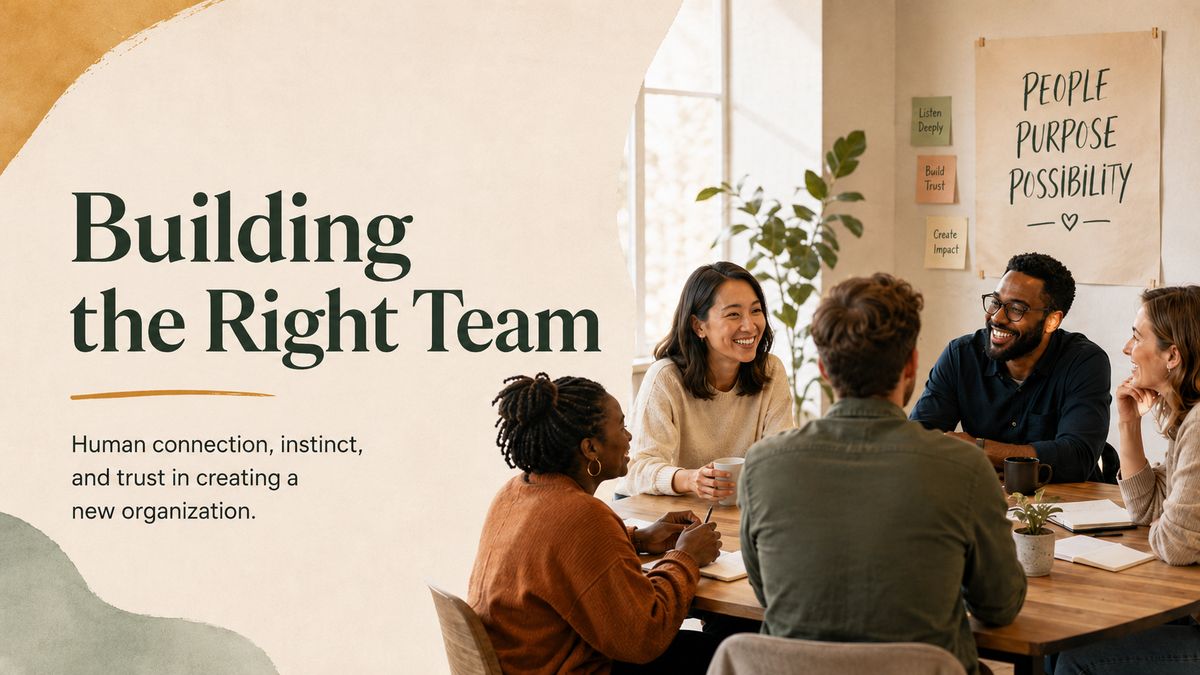
THE REAL MAGIC OF MAKING A TEAM

Putting together the team for a new organization is a creative process. There is magic as much as craft, instinct as well as care, and a sense of wonder as the team gels. I have done this several times in my life, and I have some experiences and lessons to share. There is no formula, but I do have one clear message: This about human connection and AI is not the answer. “I am coming to work for you” Lerato (not her real name) kept phoning me in the early days (around 1990) of the Centre for Health Policy that I co-founded and co-directed at Wits Medical School in Johannesburg. She was a nurse in the public service and she wanted to work with us. We just didn’t have a job for a nurse. “One day you will”, she always said. Eventually we created a junior researcher position and hired her. She was brilliant, stayed some years, and then moved on. Despite some extreme hardships she now has a PhD and two honorary doctorates, and is recognized across the African continent as a leading (and highly spiritual) figure in aspects of traditional health. Five years later I was recruiting the first employees for a nonprofit company that financed build contractors. – a collaboration between the new democratic government and one of the largest foundations in the world. Into my life walked Noxolo (not her real name), larger than life, unparalleled networker with expertise and experience that I certainly didn’t have. For the next five years, as deputy CEO she set the standard for ambition, imagination AND accountability. She moved on to an extremely successful business career, while continuing to support small business development. She could have worked anywhere. Once, when I asked her why she came to us, she just said: “I wanted to work with you”. I never got any other explanation. I used to think I had great leadership development capacities. I can name ten or more people who worked in organizations I founded, and then moved on to the very highest levels of government, academia and the private sector. I must have had something to do with that, right? I recognize now that they contributed more to the success of the organizations I led than anything I may have contributed to their success. Let me describe what I have learnt about putting together the special team you need to do special things. The right people will find you This is an unexplained mystery. Of course you will advertise and interview and have protections against nepotism. In my experience, if you are doing something worthwhile, many of the best colleagues, like the two above, just walk through the door (or kick it down) or get referred to you by the network that wants you to succeed. They will work with you for a while then go on to do other wonderful things. The real skill lies in recognizing them when they arrive. I can’t tell you how to do it, but here are some guidelines First look for energy People can learn new skills – but if someone comes to talk about work and doesn’t show you their energy, just walk away, however skilled they are. Building something new requires energy above all else. This doesn’t have to be “set the place on fire” energy that bubbles and lights up the room. It can be a quiet determination that says “This is my thing and I am going to get it done. I don’t want to be doing anything else right now.” You will know it when you see it. Be open to the unexpected (or unplanned) At the Centre for Health Policy we found ourselves with a Women’s Health Programme and Mental Health Policy programme which were not part of the plan. The right people came with the right energy and ideas, and the new initiatives flourished and contributed to the richness of the work of the centre. Your plan derives from the best ideas you had at the time. True leadership requires that you are open to the excellent ideas of others. Trust your gut, and never settle You know what you need in new team members – and you will recognize the skills and energy you are looking for. Sometimes a long unsuccessful search, or pressure from (say) the Board to fill an important position leads to employing someone who you know instinctively, is just not the right fit. If you have to make a temporary appointment do it. But the wrong appointment leads to incalculable costs in morale, wasted energy and settlement payments. Just don’t do it. Build the team and set them free Your job is to find the right people (or let them find you); ensure that the mission, strategy and plan is clear, create the team spirit and then let go – you have plenty of other things to do. This is not about neglect. But if you chose the best people, then let them get to work with within an established framework of trust, support and accountability. If someone resigns, let them go I have regretted it every time I have talked someone out of leaving. They want to go for a reason. More money or your power of persuasion won’t change that. The push factor remains. AND, when you persuade someone not to leave it puts enormous power in their hands – because if you have asked them to stay once, you will do it again, and they know you will tread carefully around them. And their colleagues will watch with suspicion that they are getting special treatment because you are desperate to keep them. Final Word Sometimes the nonprofit sector seems buried in tools and templates and frameworks and reporting requirements and job descriptions. Before you get to them, you need to have the right people in the right place. Finding and building that team is an intensely personal and human process. Nothing else works as well as it should if you do not get that first bit right. It is (literally) magic when it works.

07 Jul, 2026 11:04 Read more

A High-Impact Team Culture Strategy You Might Be Missing

Do you know the #1 reason why people quit their jobs? According to OC Tanner research, "79 percent of employees who quit their jobs claim that a lack of appreciation was a major reason for leaving." Early in my career as a manager, I vividly recall discovering this Gallup research: employees who receive recognition and appreciation at least once a week are significantly more productive and engaged, and less likely to leave their organizations. While I understood the importance of appreciation, I was surprised by just how frequently it needs to occur. Appreciating our team members for their hard work isn't just the right thing to do for them as valuable contributors; it also makes strategic sense for anyone concerned with team impact. Regular appreciation reduces turnover, boosts productivity, and benefits those who express appreciation. For nearly two decades, I've been deeply engaged in workplace appreciation. Through leading workshops, retreats for teams, and coaching executives on recognizing their teams, I've gathered valuable strategies to help integrate appreciation into everyday work. Start simple, and dream big too. Fair compensation and genuine time off are crucial for team well-being. Appreciation shouldn't replace fair wages or healthy workplace practices—if these issues exist, they must be addressed promptly. However, don't delay building a culture of appreciation while tackling more significant systemic changes. Send a quick text or Slack message right now to thank someone for their work on a project. Begin your next meeting with a round of shout-outs. You can start fostering appreciation today alongside your broader goals. Make it specific so that it is meaningful. Appreciation has to be more than "Hey, thanks!" or "Great job on the budget presentation!" Get specific about what you appreciated and the impact someone has had. You need not give a long speech or write a novel to say thanks, but a few specifics about what made their work so great will take the impact of your appreciation up many notches. Systematize it. If you want to appreciate team members more, put systems in place to make that easier to do amidst all that you're juggling. Set a weekly reminder to send out an appreciation or two. Add a recurring part of a team meeting agenda (and don't skip it!) to invite others to give each other recognition for good work done. Add to a project or event checklist to call the question of how appreciation can be built into the next time we do this project or event. Start a Slack channel or Google Space called #kudos and ask team members to express their appreciation for each other as soon as they think of it. Use a system like Thanks to give everyone on your team a budget for sending small thank-you gifts to each other. Make time to discuss appreciation directly. The best way to invest in a culture of appreciation is to discuss why it matters with your team and invest everyone in creating that culture. For my clients, this often looks like spending a few hours of a retreat or workshop discussing the research on appreciation, diving into how individuals like to be appreciated (we often use this book and its associated quiz as a tool), and brainstorming how to build that recognition into their existing systems. But you can also start small as well. Play Totem together as a team (when I was a nonprofit Executive Director, I'd bring this game to team happy hours). End your next team meeting with 10-15 minutes doing this easy activity . Appreciation resources you can use today To support you in doing this with as little friction as possible, I've created an Appreciation Toolkit with a sample session facilitator's guide, handouts, a slide deck, and lots of appreciation-at-work resources that you can get for free at www.jessicaeastmanstewart.com/appreciation . I hope it's so helpful! Jessica Eastman Stewart

03 Jul, 2026 05:25 Read more

Nonprofit Organization's Board & Governance: Five Board Models and the Risks They Hide (Coaching Reflection)

Governance is one of those words that sounds procedural until you have sat with an organization in the middle of a crisis that a stronger structure might have prevented. Over the course of my coaching practice, I have worked alongside nonprofit leaders, board chairs, and executive directors navigating some of the most consequential decisions their organizations have ever faced. What I have observed, consistently and across very different organizations, is this: the governance model chosen at the foundation of a nonprofit does not merely shape how the board operates. It shapes whether the mission endures. This article reflects on five commonly used nonprofit board governance models through the lens of that coaching experience. For each model, I examine its design logic, the risks it carries structurally, and the strategic response that coaching work suggests is most useful. The aim is not to prescribe a single correct model, but to offer a grounded, practice-informed reading of how each one performs under real organizational pressure. The governance literature, particularly the work of Carver (2006), provides the theoretical scaffolding here. The observations and strategic reflections are drawn from practice. Why governance is a strategic decision, not an administrative one Most nonprofit leaders I meet treat their governance structure as a formality. Something the lawyer set up. Something that lives in the bylaws. Something to revisit when there is a problem. That is a costly mistake. Your governance model determines who holds power, who bears accountability, how decisions get made under pressure, and how your organization weathers the inevitable seasons of conflict, transition, and resource scarcity. It is not administrative scaffolding. It is the architecture of your leadership culture. Governance model & Strategies for Risk Management: There are five governance models most commonly used in the nonprofit world. Each one has a distinct logic, a distinct appeal, and a distinct set of risks that leaders often do not see until they are already living inside them. Model One: The Advisory Board Model In this model, the CEO or president selects a trusted group of individuals whose skills, networks, and reputations lend credibility and momentum to the organization. These advisors typically volunteer their time. They consult, they open doors, they elevate the brand. For organizations in early growth stages or those with high public relations ambitions, this model can be enormously effective. I think of a health advocacy nonprofit I worked with some years ago. Their advisory board included two physicians, a former government official, and a well-known philanthropist. Fundraising tripled in two years. The executive director was talented, driven, and deeply connected to the mission. Things looked extraordinary from the outside. Then the executive director made a financial decision that, in hindsight, should have required board approval. No one was watching for it. No one had been set up to watch for it. The advisory board had no formal accountability mechanism. When questions arose, there was no clear process for investigation, no record of delegated authority, and no way to hold anyone responsible without damaging relationships that the organization depended on for its survival. This is the structural vulnerability of the Advisory Board Model. It was built for influence, not oversight. Risk: Accountability becomes personal, not structural. When board members face liability, the mechanisms to assign it clearly simply do not exist. Strategy: Define the advisory role in writing. Build a parallel small governance committee with formal fiduciary duties. Never let the advisory model function as your only governance layer. Model Two: The Patron Governance Model This model attracts board members for a specific reason: their wealth, or their access to it. The primary function of the board is fundraising. Members contribute personally, introduce major donors, and open the organization to networks it could not otherwise reach. It shares surface similarities with the advisory model, but the dynamic is distinct. Patrons give. That giving is their power. The risk I see most consistently here is a slow erosion of mission clarity. When the people who fund an organization also sit on its board, the temptation to shape programs toward donor preference rather than community need can become irresistible. I have watched organizations subtly shift their theory of change over three years because certain board members were enthusiastic about particular approaches and their enthusiasm came with money attached. Equally, because patron boards are not typically built for strategy or organizational planning, gaps in leadership vision tend to go unaddressed. The board can sustain the organization financially while it drifts strategically, which is a particular kind of dangerous because the drift is quiet and comfortable. Risk: Financial power substitutes for governance authority. Vision and planning get neglected because the board was never built for them. Strategy: Create a formal separation between fundraising duties and governance duties. Bring in at least two board members specifically for strategic and planning capacity, independent of their financial contributions. Model Three: The Cooperative Governance Model Some organizations have no executive director. No president. No single person at the helm. Decisions are made collectively, by a board of equals. Every voice carries the same weight. Every vote holds the same value. This is democracy in its most direct organizational form, and it is often used in community-rooted nonprofits where the law requires a board but the organizational culture resists hierarchy. The story I think of here is a cooperative arts collective I spent time with during a consulting engagement. When things were good, the energy in that room was remarkable. Everyone felt ownership. Everyone showed up with something to contribute. The decisions they made together were often richer and more nuanced than anything a single leader would have produced. But when a conflict emerged between two founding members about the direction of the organization, there was no mechanism to resolve it. Neither person had more authority than the other. The board was gridlocked. And because accountability for individual actions was distributed equally, no one could be held distinctly responsible for the breakdown in trust that followed. Three years of momentum stalled in a matter of months. Risk: Personal morale and interpersonal dynamics hold disproportionate power over organizational decisions. There is no way to enforce accountability for individual actions. Strategy: Build explicit conflict resolution processes into your bylaws before you need them. Designate a rotating facilitation role for board meetings. Consider a small external advisory panel for moments of impasse. Model Four: The Management Team Model In this model, the board does not just govern. It operates. Rather than hiring staff for HR, finance, fundraising, and communications, the board organizes itself into committees that do the work directly. This rose to prominence in the 1970s and remains common in volunteer-led organizations: parent associations, scouting groups, hobby and community clubs, neighborhood associations. It is an elegant solution to a real problem. Many small nonprofits genuinely cannot afford dedicated staff. Having board members step into functional roles allows the organization to operate with minimal overhead. The pattern I watch for with this model is the committee chair who stops delegating. Who begins making decisions unilaterally because they know the work better than anyone else. Who becomes, in effect, a manager without a supervisor. When that happens across multiple committees simultaneously, you have an organization where five or six people are each operating their own small fiefdom, making inconsistent decisions, and quietly resenting each other for overstepping into shared territory. The board, which was supposed to be a governance body, has become an operational one. And no one is watching the whole. Risk: Board members slip into micromanagement. Decision-making becomes inconsistent across committees. Staff morale erodes when the lines between governance and operations blur. Strategy: Set written committee charters with explicit authority limits. Conduct an annual governance audit to check whether committees are governing or operating. Hire a part-time coordinator before the pressure to micromanage becomes structural. Model Five: The Policy Board (Carver) Model This is perhaps the most structured of the five. Developed by psychologist and governance consultant John Carver, this model draws a clear and deliberate line between the board and the CEO. The board governs through policy. The CEO executes. The board does not manage staff. It does not sit on operational committees. It sets the boundaries within which the CEO operates and evaluates whether those boundaries are being honored. What makes this model compelling is the clarity it offers. Board members know their role. The CEO knows her authority. Recruitment into the board is values-driven. There are few standing committees, which keeps the board focused and efficient. What I have seen strain this model, though, is an imbalance of trust. When the board trusts the CEO deeply, the model hums. But when new board members arrive with different expectations, or when the CEO's performance becomes a genuine concern, the model provides limited mechanisms for early, constructive intervention. The space between policy oversight and operational reality can become too wide. By the time the board has grounds to act formally, a great deal may already have gone wrong informally. Risk: Limited early warning systems for leadership issues. The board can become too distant from organizational reality. Trust, once broken between board and CEO, is hard to repair within this structure. Strategy: Build quarterly informal touchpoints between board members and senior staff that do not violate the governance model but reduce information gaps. Invest in CEO evaluation processes that are ongoing, not just annual. Consider combining this model with a targeted advisory layer for specialized domains. What I have learned sitting in these rooms No governance model is inherently superior. Each one was designed for a particular kind of organization at a particular stage of its development, and each one carries its own particular version of risk. The question is never which model is best in the abstract. The question is which model fits the organization you actually are, right now, with the people you actually have. What I do know is that the organizations I have seen navigate crises well almost always had one thing in common: their boards had talked about governance before they needed it. They had named their model. They had identified its weaknesses in advance. They had built, deliberately and imperfectly, the kind of structure that could hold weight when pressure arrived. If you are leading a nonprofit, I want to ask you a simple question: can you name your governance model today, explain why it was chosen, and describe where its structural weaknesses sit? If the answer is no, that is where the conversation needs to start. Not after the next crisis! Now, when you still have the space to think clearly and build well. Produced by Sabnam Mostari ( Click into her profile to book a call with her for coaching support) References Carver, J. (2006). Boards that make a difference: A new design for leadership in nonprofit and public organizations (3rd ed.). Jossey-Bass. Anonymous. (n.d.). Advisory board governance model [Unpublished reference document]. Source material provided for this article. Covers the Advisory Board, Patron, Cooperative, Management Team, and Policy Board governance models as applied to nonprofit and for-profit organizations. Sabnam Mostari is a Board & Governance coach and mentor. She works with profit & nonprofit organizations, social enterprises, and purpose-driven leaders on board structure, organizational culture, and strategic leadership transitions.

08 May, 2026 10:23 Read more

Consulting with Joy-Cedric de Beer

“I know that we have had a good week with my team when I go home on Friday with joy in my heart”. Almost nothing surprises me anymore, but this nearly lifted me out of my chair. “Put that in your logframe and smoke it” was my first, uncharitable thought directed at the architects and enforcers of modern bureaucratic development practices. I had been doing some leadership coaching for Nyanam – an extraordinary NPO supporting widows organizing in the Kisumu district of Kenya. As our time ended the CEO asked that I have a two hour session with her senior leadership team (“The SLT”) I had asked the question as a conversation starter: What has happened in the SLT if you go home on Friday and say: “That was a good week”? The other answers were good; “The organization has met its KPIs for the week.” “We have worked together well and solved problems”. “We have made good decisions and supported each other”. Then Jackie Odhiambo the CEO said: “I know I have had a good week with my team when I go home on Friday with joy in my heart.” Something shifted for me. I have been on LinkedIn for nearly ten years posting critiques of mechanistic approaches to development: I have decried the idea that you can change the world one project at a time; that you can measure your impact through numbers when there are so many other factors at play; I have challenged the notion that every project needs a theory of change when the question you need to be asking is: “Did the marginalized gain power so they can change things for themselves?” – and the answer to that question is never a number. I have argued that it is almost as if the current approach has been designed to hide the need for systems change. As I reflected on Jackie’s words I thought to myself:- “It is even worse – project design and reporting processes smother the very essence of what it is to be human”. This blog is inspired by Nyanam, but it is not about the organization. I could not possibly do justice to what it has accomplished in a few short years, or the dynamism of the team, their commitment to widow led development initiatives or the power of the “Voice of Change” philosophy they have developed. You can find their story here No-one I have ever met is filled with joy while populating a logframe, or converting outputs to outcomes for their M+E process. But we internalize the distorted reality that this is how “success” is measured. The world’s most powerful men (they all seem to be men) sow destruction and despair worldwide. This is painful to witness – and the pain get sharper as one grows older and the likelihood of justice in one’s lifetime recedes. In the last few years I have had the privilege to work with many people doing extraordinary work supporting the marginalized to (re)claim their power – in health care, agriculture, in fisher communities, early childhood development and the power of organized women. We have worked together on governance, strategy and individual and team leadership. I am grateful for the opportunity to contribute to their work. But I am even more grateful for the opportunity to learn from them, and for the hope they inspire – that humanity really could build something new and beautiful and humane. This is the joy that I intend to bring to my work in future. And I hope to help others find their way through the bureaucracy that distorts development goals and to the humans on the other side.

23 Apr, 2026 11:27 Read more

The Power of Small Fixes for Neuroinclusion: Clarity, Meetings, and Workload in Mission-Driven Teams

Nat works with mission-driven organisations to build more neuroinclusive workplaces through practical changes to communication, systems and team culture. For Neurodiversity Celebration Week, Nonprofit Builder has handed the blog over to us at Divergent Thinking for a very natural reason. Over the past months, we have already been in conversation through webinars, Founders’ Clinic work, and practical support around the realities facing small, mission-driven teams. Most recently, that included our session for the NPB community, “Neuroinclusion 101 for NGOs: simple changes, real impact,” where we looked at how neurodiversity shows up in lean teams and how small, low-effort changes can reduce everyday friction. That conversation felt like a strong fit for Nonprofit Builder because the overlap is clear. NPB cares deeply about the kind of organizational strengthening that makes good work sustainable: clearer systems, healthier team culture, stronger communication, better onboarding, and practical “small fixes” that unlock bigger change. At Divergent Thinking , our focus is on helping organizations build workplaces where neurodivergent people can thrive —not through abstract policy language alone, but through day-to-day changes that improve how work actually feels and functions. So today’s guest blog sits exactly at that intersection. Because in mission-driven organizations, people often carry more than their role title suggests. They hold relationships, community trust, emotional labour, donor expectations, institutional memory, urgent requests, and the quiet pressure to keep things moving no matter what. In small teams especially, that weight is rarely distributed neatly. This is one reason neuroinclusion matters so much in nonprofits. Not as a large HR initiative. Not as a policy document that sits unread. But as a series of small, practical fixes that reduce friction in daily work. This is something I have seen clearly through my work with Divergent Thinking, and also through the webinar I recently delivered for Nonprofit Builder, “Neuroinclusion 101 for NGOs:simple changes, real impact.” In that session, we explored how neurodiversity shows up in lean, mission-driven teams and how small shifts, clearer instructions, calmer meetings, better flows, simple ways to agree adjustments, can improve both wellbeing and performance. The core message was simple: people are often not struggling because they are incapable. They are struggling because the way work is organised creates too much invisible load. What is invisible load? Invisible load is the hidden mental effort required to decode work rather than do it. It can include: ● trying to work out what is really expected ● tracking decisions from unstructured meetings ● switching between tasks without clear boundaries ● making sense of vague requests ● remembering verbal updates with no written follow-up ● trying to look “fine” while quietly overloaded For neurodivergent staff, including people with ADHD, autism, dyslexia, and dyspraxia, this load can be especially high. But it does not only affect neurodivergent people. When systems are unclear, fragmented, or heavily dependent on guesswork, the whole team feels it. This is why neuroinclusion is such a practical lens for nonprofits. It often improves communication, reduces misunderstanding, and protects people from quiet burnout. The hidden strain of “normal” nonprofit work In many nonprofits, certain patterns become so familiar that they stop being questioned: ● everything is urgent ● meetings are loosely structured ● roles expand faster than they are clarified ● communication happens across too many channels ● people are expected to “pick things up” ● decisions are made verbally and half-recorded Because everyone is committed, these patterns can continue for a long time without being named. But they create drag. A staff member may not be “underperforming.” They may be spending large amounts of energy figuring out priorities, interpreting unclear messages, or trying not to miss something important in a flood of communication. Mission-driven work already asks a lot of people. It should not also ask them to decode the system every hour of the day. Neuroinclusion often starts with better design, not diagnosis One of the most useful shifts for small organizations is to stop waiting for a diagnosis conversation before making work easier to navigate. A better starting question is: Where is the unnecessary friction? That question moves the conversation from blame to design. It helps teams ask: ● what is unclear? ● what is creating avoidable overload? ● what part of this process relies too much on memory, inference, or improvisation? ● what would make this easier to follow for everyone? This is where small fixes become powerful. Small fix 1: Make expectations more explicit In many values-led teams, a lot is carried through goodwill and implied understanding. That can feel efficient, but it also creates confusion. Phrases like: ● “Can you take this forward?” ● “Let’s do this soon” ● “Use your judgement” ● “This should not take long” can mean very different things to different people. A simple neuroinclusive adjustment is to make expectations more explicit: ● What is the outcome? ● What is the deadline? ● How urgent is it really? ● Who owns the next step? ● What does “done” look like? This is not about becoming rigid. It is about reducing unnecessary ambiguity. Small fix 2: Give meetings more structure Meetings are one of the biggest sources of invisible load in nonprofit work. They become especially draining when they are: ● agenda-light ● overly verbal ● unclear about purpose ● weak on decisions ● weak on actions and ownership In the NPB webinar, one of the themes we discussed was how “calmer meetings” can be one of the quickest, lowest-effort changes a team can make. That does not mean fewer honest discussions. It means a bit more structure. Helpful shifts include: ● sending a short agenda in advance ● naming the purpose of the meeting at the start ● capturing decisions as they happen ● ending with actions, owners, and timelines ● sending a brief written summary afterwards These changes reduce rework and help people track what matters. Small fix 3: Reduce “everything is urgent” culture Urgency is real in many nonprofits. But when everything is treated as urgent, priorities blur. This becomes especially hard for staff who already find planning, prioritisation, or task-switching effortful. If there is no difference between “important,” “immediate,” and “this can wait,” then people carry the stress of all of it at once. A simple neuroinclusive shift is to become more deliberate about priority-setting: ● label what is urgent versus what is important ● name what can wait ● review workload regularly ● make trade-offs visible when something new is added This does not remove pressure. It makes it easier to navigate. Small fix 4: Use templates for recurring work One of the easiest ways to reduce invisible load is to stop rebuilding routine communication from scratch every time. Templates help with: ● meeting notes ● project briefs ● handovers ● onboarding checklists ● supervision summaries ● event planning ● internal updates Templates reduce ambiguity and create consistency. In small teams, that can save far more time than people expect. Small fix 5: Normalize asking what helps Many neurodivergent staff have spent years trying not to seem difficult. That means they may not always say what is hard or what would help. Leaders can change this by making the conversation ordinary. Simple questions help: ● “What helps you work at your best?” ● “What tends to make this easier or harder?” ● “How would you prefer this information?” ● “Is there anything we could make clearer next time?” The point is not to create special processes for a few people. It is to build a culture where clarity is normal and support is not treated as exceptional. Why this matters for burnout and retention Burnout in nonprofits is often framed as the result of caring too much or carrying too much. That is certainly part of the picture. But another part is cumulative friction. When people spend large amounts of energy navigating unclear systems, managing overload, masking strain, or compensating for weak processes, exhaustion builds quietly. This is where neuroinclusion becomes a retention issue, not just a wellbeing issue. Small fixes can protect capacity before people disengage, shut down, or leave. A final reflection One of the things Nonprofit Builder understands well is that organizational development doesnot always begin with a large intervention. Sometimes it begins with a small fix: ● a clearer brief ● a better meeting summary ● a calmer workflow ● a useful template ● a more honest conversation about what helps These changes do not look dramatic. But they can be transformative. Because when teams spend less energy decoding work, they have more available for the work itself. And in mission-driven organizations, that matters twice: for the people doing the work, and for the communities depending on them. To explore more about neuroinclusive workplaces and practical training for teams, visit Divergent Thinking or read more on the Divergent Thinking blog.

17 Mar, 2026 05:22 Read more
The Future Is Collective: A Book for Our Times
NNiloufar Khonsari

The Future Is Collective: A Book for Our Times

Recommended Reading for the Nonprofit Builder Community At Nonprofit Builder, we know that many of you (consultants, coaches, facilitators) are walking alongside organizations during pivotal moments. Whether you're supporting strategic planning, leadership transitions, HR evolution, or team-wide culture shifts, you’ve likely noticed something important: even as external pressures intensify, internal challenges like burnout, conflict, financial strain, and turnover are leading to a real internal reflection on how organizations work. The ways we’ve inherited to work and lead, often modeled on strict top-down or extractive systems, no longer work for many organizations. That’s why we’re excited to share The Future Is Collective, by Niloufar Khonsari, as a standout resource for this moment. This book is a grounded, practice-based reflection shaped by Khonsari’s extensive experience - from co-founding and leading the worker-led nonprofit Pangea Legal Services to coaching and consulting with more than 100 social justice organizations. The insights in this book come directly from those lived experiences, both inside organizations and in partnership with teams navigating real challenges. Much of the book draws on best practices from highly effective, values-aligned organizations, including Pangea, which many peer consultants describe as one of the most well-functioning and intentional organizations they’ve encountered. What makes The Future Is Collective especially useful for the Nonprofit Builder network is its wide applicability. The book centers collective leadership and care, but does so through clear tools and case examples that work across team sizes, issue areas, and stages of development. With over 50 pages of appendices, it includes job descriptions, salary models, onboarding tools, decision-making frameworks, conflict practices, and other resources that leaders can use and adapt immediately. Who will find this especially helpful: Consultants and facilitators looking for practical frameworks to support organizational change, HR practices, and cultures of care - beyond checklists and one-off DEI sessions. Executive directors and senior leaders navigating accountability, participatory decision-making, and the everyday tensions of building values-aligned organizations. Board members and funders who want to meaningfully support internal culture work—not just external outcomes. Managers and staff who want to bring more clarity, alignment, and trust into how decisions are made—and explore new ways to share power in their teams. The Future Is Collective has resonated widely, earning a starred review from Publishers Weekly and features in Stanford Social Innovation Review and Nonprofit Quarterly . These recognitions reflect how hungry our field is for honest conversation, practical tools, and more human ways of leading and organizing. If you’re advising organizations through change, complexity, or care-centered strategy, The Future Is Collective is a resource worth having at your side.

17 Dec, 2025 12:25 Read more

WHEN BOARDS GO WRONG

In a previous article entitled “governance is good for you” I described effective governance and board functioning as being like a social contract – it describes how things work, who is responsible for what, and the policies and procedures necessary to make sure that everything does, in fact, work as intended. Anyone who has spent time in the non-profit sector knows that sometimes things can go very wrong: - there can be conflicts inside an organization that are not dealt with, or strained relations between the board and the executive. Both situations make for difficult working conditions and negatively affect the organization’s ability to deliver on its mandate. In this article I highlight some common problems and ways to deal with them – although the starting point must be that every situation is unique.  The Board Interferes in the work of the executive or even tries to run the organization The Board is responsible for ensuring that the organisation is fulfilling its mission with an appropriate strategy and plan, that staff are well selected and supported, that resources are efficiently used for the agreed purposes and that legal, accounting and reporting obligations are being met. The board and its committees should receive detailed reports, scrutinize them, ask for more information and can decline to accept reports or approve the annual budget and plan although this should always go with guidance as to what improvements are needed. However, problems arise when the board seeks to take over the role of the executive or issue instructions to staff members. This leads to tension, bickering and a very confusing situation for staff. Avoiding this difficulty Boards should have their eyes everywhere and their hands nowhere Boards need a clear, short, and simple charter, defining the scope of their authority and responsibilities, including dispute resolution mechanisms, and when and how the board should step in if absolutely necessary. CEOs and board chairpersons need to spend time agreeing on how to work together for the good of the organization. Stakeholders served by the board should take the trouble to ensure an effectively functioning board.  The board is ill equipped for the task at hand Sometimes boards just don’t have the right skill set or don’t meet often enough or can’t get a quorum. This can happen when the board is too large, directors have served for too long and either don’t have the interest or are no longer up to date on the kind of work being done. Avoiding this difficulty Boards should be carefully chosen with a diversity of skill sets. The board charter should include a succession policy that makes sure new expertise is brought on and long serving directors rotate off the board. Succession needs to be carefully planned so as to retain institutional memory. This allows for growth built on a sound foundation. It can be difficult or embarrassing to implement but is crucial for organizational renewal.  The board meetings are ineffective There is nothing worse than sitting through a half day board meeting and not spending real time on the important issues, and not making the decisions that need to be made. It is not only time and money wasted, but also an impediment to effective decision making and can have a destructive effect on organizational functioning. Problems can also arise when one person with a strong personality dominates discussion shutting out contributions from others. This is usually down to a chairperson who allows discussion on each issue to go round and around, without steering towards a decision (that is properly recorded) and moving on to the next point. This poor management of the meeting is made worse by individual board members who insist on dealing with minor issues at great length so that you hardly get out of the minutes of the previous meeting before the time is up. Avoiding this difficulty Chairing a board is challenging, as is being an effective and constructive board member.Organizations should not shy away from ensuring training for the whole board and particularly the chairperson who must manage the process. A well drafted agenda that spells out key decisions and allocates times to particular sessions can help improve the flow of board meetings. And it can be necessary to have tough conversations with disruptors or pedants, and to be willing to terminate their membership if they won’t change. For larger organizations it is appropriate that more detailed board work is delegated to subcommittees where issues can be thoroughly fleshed out, with recommendations brought to the full board for final decision. It is then important that the expert work at committee level should be trusted to the greatest extent possible, so that all the issues do not get rediscussed in detail at the full board meetings  Board evaluation and facilitation The South African King Code of Corporate Governance recommends that boards should conduct a self-assessment every two years. If done properly, such an assessment can highlight the kinds of disfunctions I have described and many other issues that might be weighing down on the effective functioning of the board. It then becomes possible to develop strategies to rectify any weaknesses that need to be addressed and develop a plan to monitor progress. Because self-reflection is tricky, and because there are many sensitivities in play, it’s a good idea to find a facilitator with a good understanding of both governance and NPO functioning to facilitate such an exercise, so that all can participate as equals in the process and jointly buy into the outcome. As indicated in my previous article – boards can play a highly constructive and helpful role. It is important to make sure that they actually do so.

17 Nov, 2025 08:09 Read more

Governance is Good for You

At its best governance is a statement: “This is how things work around here. We have the policies and structures to do things right. It makes life easier for everyone. Everyone recognizes the need for governance. Funders demand it, the law requires it. And there is a lot of useful material on how to do it right. I want to make a case for the value of governance and how to do it well. I am sure that many NPO leaders recognize the need, but still resent the time taken on board meetings, audit processes, delegations of authority, HR policies etc. My contention is that governance, done well, creates both certainty and effectiveness. I spent my early working life associated with NGOs without any real governance. They were mainly small and worked fine. I never thought about governance. Two shocks changed my mind: First in 1994 I found myself chairing the board of a very reputable and significant South African NPO. The founders left, the new CEO turned out to be corrupt, and after a rapid downward spiral we closed the NPO and returned funds to the donors. Imagine if there had been no board, no whistleblowing, and no rules governing the use of the company credit card? Then in 1995 I was appointed CEO of a nonprofit financial institution supporting emerging construction businesses in South Africa. It was jointly funded by the SA Government and a large US based philanthropy. For the first two years I could not come to terms with the volume of board meetings, subcommittee meetings, staffing and remuneration policies, rules governing banking and much else. I sometimes felt that I had no time to do the work for which I was employed. Over time the benefits shone through: The board as talent and support : There were board members who brought knowledge, networks and experience that were priceless. The board as cover When clients, staff members or government officials asked for special treatment of one sort or another it was wonderful to be able to say: “That’s not in our policy, but I can check with the board you want me to.” The board as guarantor of transparency. At the end of board meetings one of the non-executive directors would look at me and ask: “Is there anything else we should know about that you have not told us?” You can be sure that the board reports were comprehensive, and all risks were well described. The board as guardian of the slippery slope. Good rules and effective oversight prevented any temptation to take short cuts. Sometimes I felt it would be convenient to fill an urgent post or consultancy with someone I knew could do the job without all the hassle of a formal recruitment process. But that is the first step on a slippery slope to nepotism. If the CEO does it once, other managers will follow suit and soon it becomes the culture of the organization. Reporting regularly to the board also makes it easier to satisfy funder reporting requirements and to produce annual reports. The information is all there and ready for use. The point is that decision making and quite a lot of the work of the executive becomes much easier when there are clear guidelines, and a board to make sure you stick to them. In the end I became an ardent convert to good governance. It’s like an organizational social contract: This is how things work and there is so much that we don’t have to think about all the time – because there are policies and processes and proper monitoring and reporting. We can just get on with our work. Bad governance can be difficult, or even toxic. That’s a topic for another blog, and that’s why it’s important to focus on getting governance right – not just for reasons of compliance, but to make sure that everyone knows how things work around here.

11 Nov, 2025 13:14 Read more