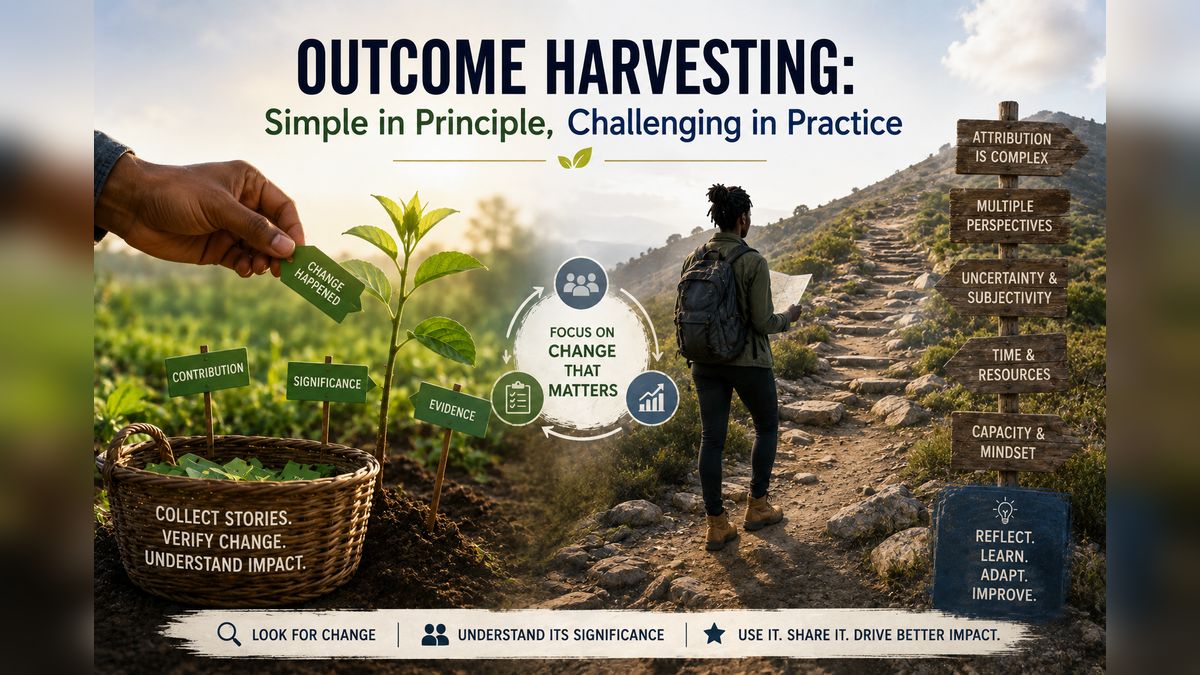
For the past decade, Outcome Harvesting has been a favoured choice of methodology for many organisations seeking to strengthen the governance of their work and use lessons learnt in their strategic planning. This is hardly surprising. Outcome Harvesting is a method for monitoring and evaluation that is conceptually straightforward at a first glance. Yet formulating, analysing and learning from outcomes – and using it for governance and strategic planning – requires considerable discipline. This article discusses some of the main challenges associated with Outcome Harvesting and what organisations applying the approach may do to overcome them to improve program governance and evidence-based strategic planning.
Malene Sønderskov, Evaluation Expert
Outcome Harvesting has gained significant popularity as an approach to monitor and govern programmatic work since Ricardo Wilson Grau and Heather Britt first introduced and described it in a guide called ‘Outcome Harvesting’, published by the Ford Foundation in May 2012. Wilson Grau later explained the approach at length in a book from 2018 called ‘Outcome Harvesting, principles, steps and evaluation application’.
Its popularity is hardly surprising. With time, more development interventions have moved from responding to immediate needs to addressing the multiple factors and actors that cause poverty and human suffering; often in causal pathways of change that are unpredictable and far from the causality that can be predicted in a vaccine program that aims to reduce morbidity or a school program that promotes learning.
Outcome Harvesting has become popular because it fits the realities of complex programmes better than many traditional monitoring approaches.
Its main attraction is that it starts with what has changed, rather than only checking progress against predetermined indicators - which might turn out to be of little relevance in a programme where constant change is the only predictable factor.
Consequently, Outcome Harvesting is especially useful in advocacy, governance, women’s rights, peacebuilding and systems-change programmes, where outcomes are indeed unpredictable and usually the result of several actors and factors, of which the intervention itself is only one.
Yet Outcome Harvesting may also be attractive for other reasons. Unlike more traditional – and quantitative – approaches, Outcome Harvesting can be applied without baseline data and with limited or no concern for control groups, sampling strategies and calculation of the data set’s statistical significance. A tempting choice, if time and resources for data collection are scarce and no one has time to design or introduce a monitoring and data collection design already at the onset of the intervention.
Yet lessons learnt from organisations applying Outcome Harvesting suggests that – as with many other things in life – the devil is to be found in the details, and that Outcome Harvesting might not be as straight forward and simple as we think. This article presents some of the challenges that we have encountered facilitating Outcome Harvesting processes with organisations all over the world. The article concludes with some recommendations or points to observe to get the full benefit of an Outcome Harvesting exercise.
Language matters
Ricardo Wilson Grau’s writings about Outcome Harvesting clearly define an outcome as a change in the behaviour, relationships, actions, activities, policies, or practices of an individual, group, community, organisation, or institution. Based on this definition, it should therefore not be straightforward to identify and formulate outcomes.
In practice, formulating outcomes can be harder than one imagines, and participants in Outcome Harvesting exercises often express uncertainty about whether their statements genuinely describe change.
One reason may lie in the language commonly used in development work. When planning interventions and describing our work, we often rely on passive constructions, abstract concepts, and broad terms such as empowerment, resilience, and capacity building. Although these terms may sound important—and may align well with donor priorities—they often reveal very little about who has changed, what these actors do differently, and why that change matters.
To formulate and harvest outcomes, we therefore need to switch to another kind of language — or even unlearn some of the language we have been socialised to use when we talk about development work.
Fortunately, the language we need to harvest outcomes resembles the language we were taught in school grammar lessons. A proper sentence, we learned, includes a subject, a verb and an object. With these three elements, we can construct a sentence that tells us who changed and what changed.
This matters. If we cannot clearly say who changed what, it becomes very difficult to analyse whether change happened — and why. A useful guiding rule is therefore to limit each outcome statement to one sentence. Clear and concise language is not a simplification of complexity. It is a precondition for understanding it.
Our expectations blur the vision
Our expectations and perceptions about what change looks like and how fast it takes place may be another reason why formulating outcomes can be difficult. A quick look at the objectives of many development interventions reveals that ambitions are often huge. Gender equality, reconciliation between conflicting groups, food security for communities affected by hunger. The list of hopeful and ambitious aims to be achieved within a relatively short period of time is often long.
When we engage in Outcome Harvesting, it is therefore hardly surprising if we tend to look for major, visible results and forget that change very often takes time and includes periods of stalemate or even regression. Yet European history proves the point: Equality between men and women, equal rights for sexual minorities, abolition of death penalty, and proper care for people with mental diseases has not materialised overnight in any country, and despite important achievements, inequality persists. Even in the most ‘advanced’ countries.
Rather than expecting and looking for quick and visible changes, it is important to remember that change is often incremental and becomes apparent through everyday decisions, interactions between people, changes of practices and behaviours. Formulating a clear outcome therefore requires us to look closely at what people or institutions are doing differently, rather than describing general aspirations, activities or desirable conditions that it may take years – or even decades – to achieve.
If Outcome Harvesting is the answer – what was then the question?
Outcome Harvesting collects (“harvests”) evidence of what has changed (“outcomes”) and, working backwards, determines whether and how an intervention has contributed to these changes.
When organisations harvest outcomes, the result is often a long list of ‘change stories’–frequently collected and organised in an outcome database that staff and other interested stakeholders can consult, if they wish to access information about the performance of their program.
Unfortunately, this treasure of information (outcomes) gathered is often left partly or fully unexplored, however.
One reason is that organisations may struggle to find the time and resources needed to make sense of all the outcomes they have collected. This includes exploring whether the outcomes reveal a pattern, whether some outcomes lead to others further along a change pathway, and whether the outcomes produced align with the outcomes originally expected.
Another reason may be that insufficient attention is paid to the purpose of the Outcome Harvesting exercise. While Outcome Harvesting may be “the answer” to many organisations’ need for monitoring data, organisations sometimes forget to ask themselves what the question was: What is it that they, as organisations, programme practitioners or MEL staff, want to know about their programme — beyond whether or not it produced outcomes?
Outcome Harvesting offers a unique opportunity for learning and strategic adjustment, but only if we invest the time and resources needed to analyse the full sample of outcomes harvested. This requires us to begin the entire Outcome Harvesting exercise by formulating clear questions that can guide the process.
Key questions to consider when analysing outcomes include – but may not be limited to:
What outcomes did we produce?
Do the outcomes we have produced fall into certain categories (e.g. policy changes, institutional changes, behaviour changes or changes in relations). Are we producing more outcomes in some categories than in others? If so, what may be the reason?
To what extent are the outcomes harvested aligned with outcomes that we expected to produce/contribute to when we formulated our program?
To what extent and how are outcomes connected in causal pathways?
What other factors and actors have contributed to the outcomes we are harvesting – and to the links between them?
And last, but not least: What do these insights tell us about how and under which circumstances change happens? And what are the implications for our program that we can draw from this?
If we forget to ask questions that can guide analytical reflection, then we risk not capitalising on the richness of the outcomes that we have harvested.
The key recommendations for Outcome Harvesting as a means to strengthen program governance
So where does that leave organisations who adopt Outcome Harvesting as a means to understand the contributions they make in contexts of complexity and who wants to invest in their ability to make sense of their results to better govern programs and ensure that new strategies are informed by evidence and lessons learnt?
Below are ten recommendations that might assist in making much more out of the Outcome Harvesting process.
Planning the harvest and formulating outcomes
Begin with learning questions. Before collecting outcomes, decide what your organisation wants to understand. Outcome Harvesting should not merely produce a database of change stories; it should generate evidence that answers strategic questions about your program.
Formulate each outcome as one clear, concrete sentence. Use a subject, verb, and object to state who changed, what they now do differently and, where relevant, why the change matters. Clear and concise outcome statements are easier to verify, compare and analyse.
Look for incremental change. Do not focus only on major policy reforms or highly visible results. Changes in everyday behaviour, relationships, decisions and practices may be important steps in a longer pathway of change.
Separate outcomes from activities and aspirations. Training people, holding meetings or producing a guide are activities. Gender equality, reconciliation and food security are broad ambitions. The outcome is the change in what a specific actor does as a result.
Harvest only what the organisation has capacity to analyse. A smaller, well-analysed set of outcomes is more useful than a large collection that remains unexplored.
Analysing outcomes
Analyse patterns across outcomes. Examine if outcomes cluster around particular actors, levels or types of change, and whether some kinds of outcomes appear more frequently than others.
Compare harvested outcomes with the programme’s theory of change. Assess if the changes align with what the programme expected, whether unexpected pathways have emerged, and whether the original assumptions about how change happens remain credible.
Explore connections between outcomes. Individual outcomes should not always be treated as isolated stories. Investigate whether one change enabled or reinforced another.
Examine contribution, not only occurrence. Consider how the intervention contributed, but also identify the other actors, contextual factors, and events that helped or hindered change.
Use findings to adjust strategy and planning. Translate lessons about how change happens into revisions of activities, partnerships, priorities and theories of change.