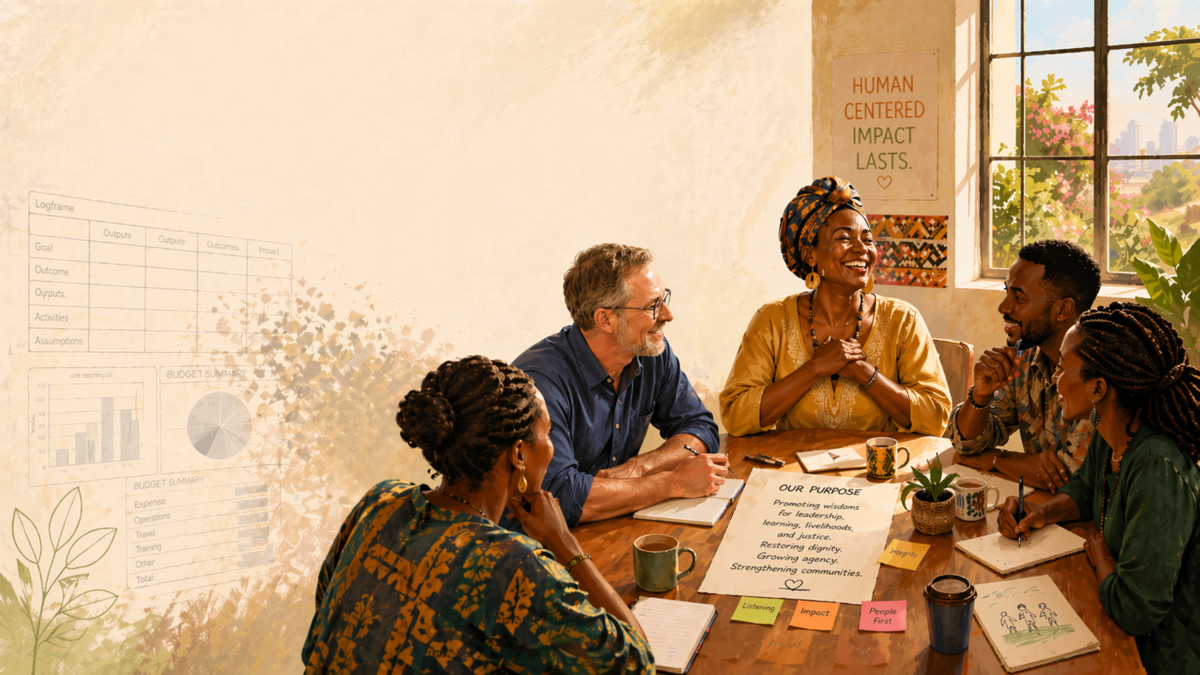
“I know that we have had a good week with my team when I go home on Friday with joy in my heart”.
Almost nothing surprises me anymore, but this nearly lifted me out of my chair.
“Put that in your logframe and smoke it” was my first, uncharitable thought directed at the architects and enforcers of modern bureaucratic development practices.
I had been doing some leadership coaching for Nyanam – an extraordinary NPO supporting widows organizing in the Kisumu district of Kenya. As our time ended the CEO asked that I have a two hour session with her senior leadership team (“The SLT”)
I had asked the question as a conversation starter: What has happened in the SLT if you go home on Friday and say: “That was a good week”?
The other answers were good; “The organization has met its KPIs for the week.”
“We have worked together well and solved problems”. “We have made good decisions and supported each other”.
Then Jackie Odhiambo the CEO said: “I know I have had a good week with my team when I go home on Friday with joy in my heart.”
Something shifted for me.
I have been on LinkedIn for nearly ten years posting critiques of mechanistic approaches to development: I have decried the idea that you can change the world one project at a time; that you can measure your impact through numbers when there are so many other factors at play; I have challenged the notion that every project needs a theory of change when the question you need to be asking is: “Did the marginalized gain power so they can change things for themselves?” – and the answer to that question is never a number.
I have argued that it is almost as if the current approach has been designed to hide the need for systems change. As I reflected on Jackie’s words I thought to myself:- “It is even worse – project design and reporting processes smother the very essence of what it is to be human”.
This blog is inspired by Nyanam, but it is not about the organization. I could not possibly do justice to what it has accomplished in a few short years, or the dynamism of the team, their commitment to widow led development initiatives or the power of the “Voice of Change” philosophy they have developed. You can find their story here
No-one I have ever met is filled with joy while populating a logframe, or converting outputs to outcomes for their M+E process. But we internalize the distorted reality that this is how “success” is measured.
The world’s most powerful men (they all seem to be men) sow destruction and despair worldwide. This is painful to witness – and the pain get sharper as one grows older and the likelihood of justice in one’s lifetime recedes.
In the last few years I have had the privilege to work with many people doing extraordinary work supporting the marginalized to (re)claim their power – in health care, agriculture, in fisher communities, early childhood development and the power of organized women. We have worked together on governance, strategy and individual and team leadership.
I am grateful for the opportunity to contribute to their work. But I am even more grateful for the opportunity to learn from them, and for the hope they inspire – that humanity really could build something new and beautiful and humane.
This is the joy that I intend to bring to my work in future.
And I hope to help others find their way through the bureaucracy that distorts development goals and to the humans on the other side.